Use CaseBirds and animals near runways
Airfield Wildlife Hazard Detection
Detect birds and animals on or near runways and taxiways from fixed or thermal cameras, supporting wildlife hazard management teams at airports.
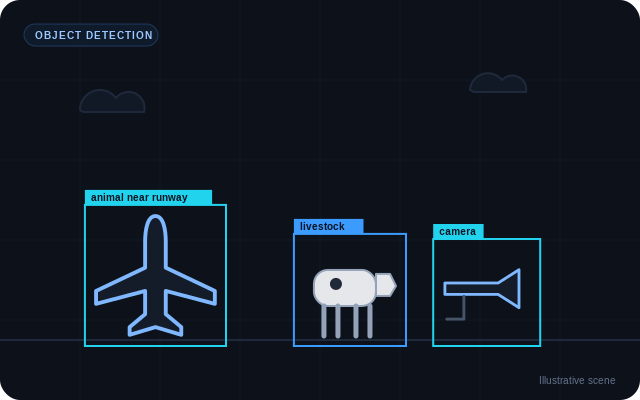
What can be checked
- Animals on or near runways
- Bird groups on the ground
- Activity patterns by time and location
What the team receives
- Alerts to wildlife control teams
- Hotspot statistics
What the solution does
Earlier awareness
Detects birds and animals on runways and taxiways between scheduled patrols, so wildlife teams can respond sooner.
Night coverage
Thermal cameras extend detection into darkness.
Planning data
Builds a record of where and when wildlife appears on the airfield, which supports habitat management and patrol planning.
The operational problem
Wildlife on airfields is a safety hazard, and patrols cannot watch every area at all times.
How visual intelligence helps
Fixed and thermal cameras detect animals and birds on the ground near runways and alert wildlife control teams with location and images.
Example visual workflow
- Cameras cover runway and taxiway areas.
- Animals and birds are detected.
- Alerts and locations go to wildlife teams.
- Patterns are summarized for planning.
Illustrative workflow — the actual pipeline is designed for each site during the PoC.
Edge deployment considerations
Airport Edge servers process video locally, in line with airport security requirements, and send only alerts and statistics.
How the solution is built
AI capabilities
The AI tasks this use case combines.
- Object Detection
Object detection finds and labels the objects in an image or video frame and marks each one with a bounding box.
- Object Tracking and Multi-Object Tracking
Object tracking links detections of the same object across consecutive video frames and assigns each one a persistent ID.
Visual inputs
Cameras and imaging that typically supply the video.
- IP and Network Cameras
IP cameras stream digital video over standard networks and are the most common source for Edge AI video analytics.
- Thermal and Infrared Cameras
Thermal cameras image heat (long-wave infrared), while near-infrared cameras use invisible illumination to see in darkness.
Deployment options
General approaches to evaluate, not tested hardware. Specific hardware is selected and validated for each project during the PoC.
- Camera and VMS Integration
Most projects start with cameras that are already installed.
- Edge AI Hardware Sizing
Sizing Edge AI hardware means matching compute, memory, power and enclosure to the real workload — the number of streams, resolution, frame rate, models and latency targets — under the site's environmental and installation constraints.
- Edge Deployment Architectures
Edge-first means processing video at or near where it is captured.
- Industrial and Ruggedized Edge AI Computers
Industrial Edge AI computers and ruggedized systems house AI-capable processors in enclosures built for factories, vehicles and outdoor sites — wide temperature ranges, vibration, dust and industrial power.
Practical factors to plan for
Real-world results depend as much on the environment and camera setup as on the model.
Site and setup
- Distance. Small birds at long range need high-resolution or thermal cameras.
- Coordination. Alerts must fit the airport's wildlife procedures.
Human review
Wildlife control staff verify sightings and decide on dispersal. Runway operations follow air traffic control decisions.
Limitations & scope
- Birds in flight at distance are difficult to detect reliably.
- Not a certified avian radar system.
Proof of Concept
Have a visual AI challenge? Let's prove it.
Share a video of what happens in your environment and describe the outcome you need. We review every request for technical feasibility, then agree the scope of a focused Proof of Concept (PoC) with you.
Example request: “We want alerts for deer and foxes crossing near the threshold of our main runway at night.”
Every request is reviewed for technical feasibility. PoC scope, timing and terms are agreed individually.
Related topics
How this page connects to industries, use cases, AI tasks, input sources and deployment options.