Use CaseFollowing the ball for event data
Ball Tracking
Detect and follow the ball in sports video to support event tagging, possession analysis and highlight generation.
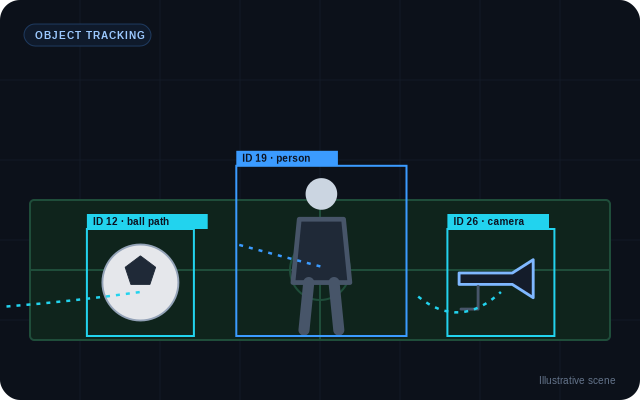
What can be checked
- Ball position in each frame
- Ball trajectory
- Possession changes
What the team receives
- Ball trajectory data
- Candidate events for tagging
What the solution does
Faster tagging
Suggests passes, shots and other ball events from the tracked trajectory, so analysts confirm tags rather than log every event by hand.
Trajectory data
Provides ball trajectories that analysts use to study possession and tactics.
Highlights
Marks key ball events so highlight clips can be cut faster.
The operational problem
Manual event tagging of matches and training is slow and expensive, which limits how much footage analysts can use.
How visual intelligence helps
The ball is detected in each frame and trajectories are built, with gaps filled where the ball is briefly hidden. Possession changes and shots are suggested as events for analysts to confirm.
Example visual workflow
- Cameras capture the play.
- The ball is detected in each frame.
- Trajectories are built and gaps filled.
- Events are suggested to analysts.
Illustrative workflow — the actual pipeline is designed for each site during the PoC.
Edge deployment considerations
Processing at the venue enables near-real-time results for coaching staff. High-frame-rate cameras may be needed for fast sports.
How the solution is built
AI capabilities
The AI tasks this use case combines.
- Object Detection
Object detection finds and labels the objects in an image or video frame and marks each one with a bounding box.
- Object Tracking and Multi-Object Tracking
Object tracking links detections of the same object across consecutive video frames and assigns each one a persistent ID.
Visual inputs
Cameras and imaging that typically supply the video.
- High-Speed Cameras
High-speed cameras capture hundreds or thousands of frames per second, revealing events too fast for standard cameras — on fast packaging lines, in machinery or in process analysis.
- IP and Network Cameras
IP cameras stream digital video over standard networks and are the most common source for Edge AI video analytics.
Deployment options
General approaches to evaluate, not tested hardware. Specific hardware is selected and validated for each project during the PoC.
- Camera and VMS Integration
Most projects start with cameras that are already installed.
- Edge AI Hardware Sizing
Sizing Edge AI hardware means matching compute, memory, power and enclosure to the real workload — the number of streams, resolution, frame rate, models and latency targets — under the site's environmental and installation constraints.
- Edge Deployment Architectures
Edge-first means processing video at or near where it is captured.
- Industrial and Ruggedized Edge AI Computers
Industrial Edge AI computers and ruggedized systems house AI-capable processors in enclosures built for factories, vehicles and outdoor sites — wide temperature ranges, vibration, dust and industrial power.
Practical factors to plan for
Real-world results depend as much on the environment and camera setup as on the model.
Site and setup
- Speed and size. Small fast balls need high frame rates.
- Occlusion. The ball is often hidden by players.
Human review
Analysts confirm automatically suggested events.
Limitations & scope
- Fast or occluded balls may be lost.
- Broadcast camera cuts break trajectories.
Proof of Concept
Have a visual AI challenge? Let's prove it.
Share a video of what happens in your environment and describe the outcome you need. We review every request for technical feasibility, then agree the scope of a focused Proof of Concept (PoC) with you.
Example request: “We want ball trajectories from our basketball court cameras to tag shots automatically.”
Every request is reviewed for technical feasibility. PoC scope, timing and terms are agreed individually.
Related topics
How this page connects to industries, use cases, AI tasks, input sources and deployment options.