Use CaseCracks, dirt and counts on grading lines
Egg Inspection and Counting
Count eggs and flag visible cracks, dirt and shape defects on collection belts and grading lines, supporting egg producers and packing stations.
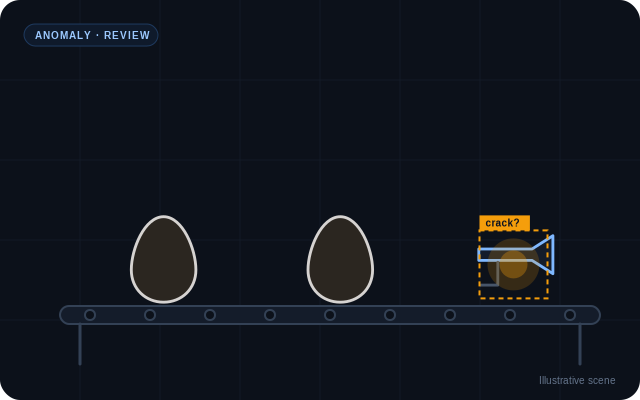
What can be checked
- Visible cracks in shells
- Dirty and stained eggs
- Misshapen or broken eggs
What the team receives
- Counts per belt or house
- Reject or downgrade signals
What the solution does
Accurate counts
Counts production per house automatically.
Quality grading
Flags cracked, dirty and misshapen eggs on the collection belt, so they can be removed before grading and packing.
Flock insight
Links counts and defect rates to each house and collection time, which helps farm managers spot changes in a flock early.
The operational problem
Egg producers need accurate production counts and must remove cracked or dirty eggs, which is hard to do manually at belt speed.
How visual intelligence helps
Cameras count eggs and highlight visible shell defects, diverting affected eggs and reporting counts by house.
Example visual workflow
- Eggs pass cameras on the collection belt or grader.
- Eggs are counted and inspected.
- Defective eggs are flagged or diverted.
- Counts are reported per house.
Illustrative workflow — the actual pipeline is designed for each site during the PoC.
Edge deployment considerations
Edge devices beside belts process images locally and send counts to farm management systems.
How the solution is built
AI capabilities
The AI tasks this use case combines.
- Counting and Measurement
Counting and measurement convert detections, tracks and masks into quantities — how many objects, how long they stayed, how big they are, how full an area is.
- Defect Detection
Defect detection locates and classifies specific, known defect types — scratches, cracks, dents, contamination, missing features — in images of products or assets.
Visual inputs
Cameras and imaging that typically supply the video.
- Industrial and Machine Vision Cameras
Industrial and machine vision cameras capture sharp, consistent images at fixed positions with controlled lighting and triggering.
Deployment options
General approaches to evaluate, not tested hardware. Specific hardware is selected and validated for each project during the PoC.
- Edge AI Hardware Sizing
Sizing Edge AI hardware means matching compute, memory, power and enclosure to the real workload — the number of streams, resolution, frame rate, models and latency targets — under the site's environmental and installation constraints.
- Edge Deployment Architectures
Edge-first means processing video at or near where it is captured.
- Industrial and Ruggedized Edge AI Computers
Industrial Edge AI computers and ruggedized systems house AI-capable processors in enclosures built for factories, vehicles and outdoor sites — wide temperature ranges, vibration, dust and industrial power.
Practical factors to plan for
Real-world results depend as much on the environment and camera setup as on the model.
Site and setup
- Fine cracks. Hairline cracks may need candling light or acoustic systems.
- Belt speed. Fast belts need short exposure times.
Human review
Packing staff review downgraded eggs and maintain grading equipment.
Limitations & scope
- Hairline cracks are not always visible to cameras.
- Grading for legal classes follows certified procedures.
Proof of Concept
Have a visual AI challenge? Let's prove it.
Share a video of what happens in your environment and describe the outcome you need. We review every request for technical feasibility, then agree the scope of a focused Proof of Concept (PoC) with you.
Example request: “We want egg counts per house and crack alerts from cameras over our collection belts.”
Every request is reviewed for technical feasibility. PoC scope, timing and terms are agreed individually.
Related topics
How this page connects to industries, use cases, AI tasks, input sources and deployment options.