IndustryCrops, livestock and farm operations
Edge AI Video Intelligence for Agriculture
Farms cover large areas with limited connectivity, and conditions change with weather and season. Edge AI video intelligence can support crop and field observation, livestock monitoring and farm security using fixed, mobile and aerial cameras.
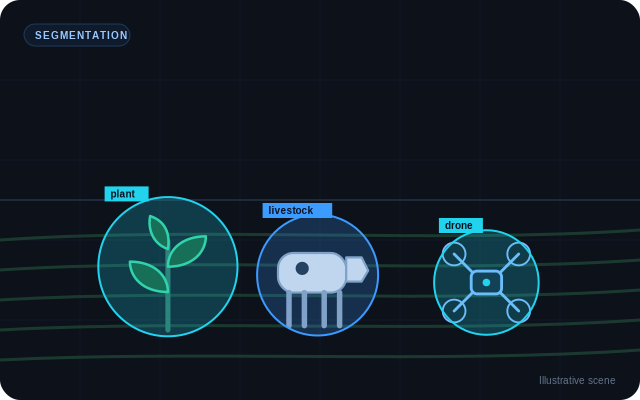
Common challenges
- Fields and pastures are too large to observe frequently on foot.
- Crop stress, weeds and damage can spread between inspections.
- Livestock behavior and condition are difficult to monitor continuously.
- Rural sites often lack reliable connectivity and power.
Typical visual sources
- Drones with RGB or multispectral cameras
- Fixed cameras in barns, sheds and yards
- Cameras mounted on tractors and agricultural robots
Potential applications
Aerial crop observation
Analyze drone imagery to highlight areas of possible stress, gaps or weeds for agronomic review.
Livestock monitoring
Count animals and observe activity or unusual behavior in barns and yards.
Farm and equipment security
Detect people or vehicles in yards and machinery areas outside working hours.
Machine-mounted vision
Support detection of plants, rows or obstacles from cameras on tractors or field robots.
Large areas, variable conditions
Agriculture spans fields, orchards, greenhouses and livestock buildings. Each poses different challenges: scale and season for crops, occlusion and behavior for animals. Edge AI video intelligence helps by highlighting what deserves a closer look, rather than replacing agronomic or veterinary judgment.
Processing near the source
Drones, tractors and field robots move far from network infrastructure. Processing onboard or on a nearby device lets results be produced in the field, with data synchronized later where needed.
Questions to answer early
- Which crop, field or livestock question matters most?
- Which platforms are available: drones, vehicles, fixed cameras?
- What decisions will be made based on the results, and by whom?
Limitations & scope
- Crop and plant health interpretation requires agronomic expertise; imagery highlights areas for expert assessment.
- Seasonal change, weather and lighting vary strongly; evaluation data should span representative conditions.
- Animal monitoring must respect animal-welfare obligations and is decision support only.
Proof of Concept
Have a visual AI challenge? Let's prove it.
Share a video of what happens in your environment and describe the outcome you need. We review every request for technical feasibility, then agree the scope of a focused Proof of Concept (PoC) with you.
Example request: “We want to count cattle entering and leaving a holding yard from a fixed camera.”
Every request is reviewed for technical feasibility. PoC scope, timing and terms are agreed individually.
Frequently asked questions
Is multispectral imaging necessary for crop analysis?
Not always. Some issues are visible in RGB imagery, while others are better captured by multispectral sensors. The right sensor depends on the question being asked.
Can processing happen in the field?
Yes. Processing can run on a drone ground station, a vehicle-mounted computer or an Edge device at the farm, so results do not depend on rural connectivity.
Related topics
How this page connects to industries, use cases, AI tasks, input sources and deployment options.
Use Cases
- Aerial Mapping and Feature Extraction
- Animal Behavior Monitoring
- Asset Tracking and Monitoring
- Crop Disease Symptom Detection
- Crop Row Detection for Machine Guidance
- Egg Inspection and Counting
- Fish Counting and Aquaculture Observation
- Foreign Material Detection in Food
- Fruit Counting and Yield Estimation
- Insect and Pest Trap Monitoring
- Lameness Indicators in Livestock
- Livestock Counting
- Perimeter Monitoring and Intrusion Detection
- Plant Growth Monitoring
- Plant Stand and Emergence Counting
- Poultry House Monitoring
- Produce Grading and Sorting
- Ripeness and Harvest Readiness
- Weed Detection for Targeted Treatment
- Wildfire Smoke Detection