Use CasePens, tanks and transfers
Fish Counting and Aquaculture Observation
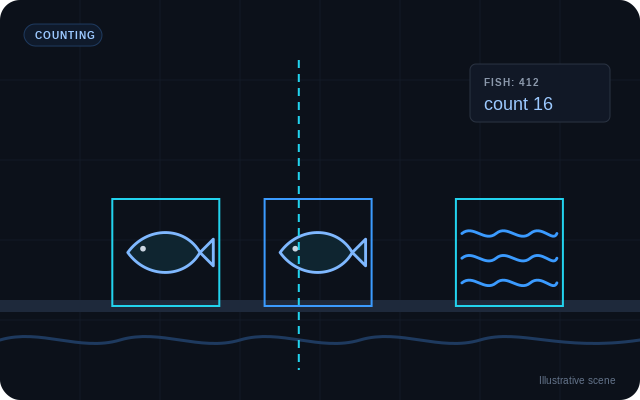
Estimate fish counts during transfers and observe feeding behavior and visible conditions in pens and tanks to support aquaculture operations.
What can be checked
- Fish passing through transfer pipes or channels
- Feeding activity and surface behavior
- Visible conditions such as surface lice indicators
What the team receives
- Count estimates per transfer
- Feeding activity indicators
What the solution does
Transfer counts
Estimates fish numbers as they pass through pipes, channels or transfer points, replacing rough estimates during moves.
Feeding insight
Provides feeding-activity indicators that help reduce overfeeding.
Remote sites
Processes video on a device at the pen or hatchery, so it can operate where internet connectivity is limited or intermittent.
The operational problem
Fish numbers and feeding behavior are hard to observe directly, but affect costs and welfare.
How visual intelligence helps
Cameras in transfer pipes and pens detect and track fish to estimate counts during moves and activity levels during feeding. Operators use the indicators to plan feeding and stock movements.
Example visual workflow
- Underwater or channel cameras capture fish.
- Fish are detected and tracked.
- Counts and activity are estimated.
- Results are reported per pen or transfer.
Illustrative workflow — the actual pipeline is designed for each site during the PoC.
Edge deployment considerations
Edge devices on barges or shore stations process video locally despite limited connectivity.
How the solution is built
AI capabilities
The AI tasks this use case combines.
- Counting and Measurement
Counting and measurement convert detections, tracks and masks into quantities — how many objects, how long they stayed, how big they are, how full an area is.
- Object Tracking and Multi-Object Tracking
Object tracking links detections of the same object across consecutive video frames and assigns each one a persistent ID.
Visual inputs
Cameras and imaging that typically supply the video.
- IP and Network Cameras
IP cameras stream digital video over standard networks and are the most common source for Edge AI video analytics.
Deployment options
General approaches to evaluate, not tested hardware. Specific hardware is selected and validated for each project during the PoC.
- Camera and VMS Integration
Most projects start with cameras that are already installed.
- Edge AI Hardware Sizing
Sizing Edge AI hardware means matching compute, memory, power and enclosure to the real workload — the number of streams, resolution, frame rate, models and latency targets — under the site's environmental and installation constraints.
- Edge Deployment Architectures
Edge-first means processing video at or near where it is captured.
Practical factors to plan for
Real-world results depend as much on the environment and camera setup as on the model.
Site and setup
- Water clarity. Turbidity strongly affects underwater visibility.
- Overlap. Schools of fish overlap heavily.
Human review
Farm staff use estimates for planning. Health assessments remain with specialists.
Limitations & scope
- Counts in pens are estimates.
- Biofouling of cameras degrades results.
Proof of Concept
Have a visual AI challenge? Let's prove it.
Share a video of what happens in your environment and describe the outcome you need. We review every request for technical feasibility, then agree the scope of a focused Proof of Concept (PoC) with you.
Example request: “We want count estimates of smolt passing through our transfer pipe camera.”
Every request is reviewed for technical feasibility. PoC scope, timing and terms are agreed individually.
Related topics
How this page connects to industries, use cases, AI tasks, input sources and deployment options.