Use CaseDebris on aprons, hangars and work areas
Foreign Object Debris (FOD) Detection
Detect loose objects such as tools, fasteners, packaging or debris on aprons, taxiways, hangar floors and assembly areas, so they can be removed before they cause damage.
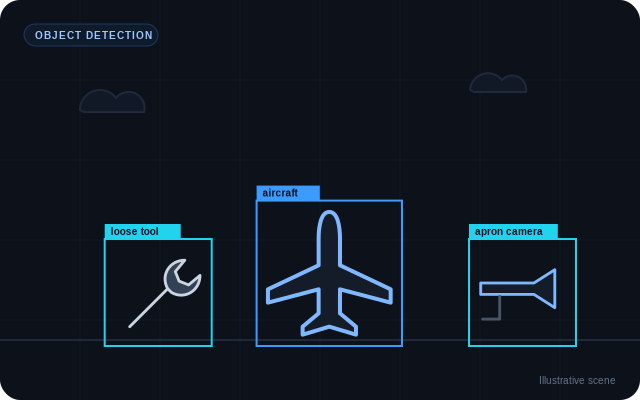
What can be checked
- Tools and fasteners or small parts on the ground
- Packaging and rags or other loose material
- Objects left in defined clean zones
What the team receives
- Alerts with location and snapshot
- FOD event log for safety reporting
What the solution does
Between-walk awareness
Highlights debris between scheduled FOD walks.
Location guidance
Shows where an object was seen to speed up removal.
Safety records
Builds an event history to identify recurring sources.
The operational problem
Loose items in areas where aircraft or engines operate can be ingested or cause damage. Manual FOD walks happen at intervals, so objects can remain unnoticed in between.
How visual intelligence helps
Cameras watch a defined surface and a model flags objects that should not be there. Staff receive the location and a snapshot, which helps them act quickly and understand where debris comes from.
Example visual workflow
- Cameras cover a defined apron stand or hangar zone.
- A model detects new objects that do not belong on the surface.
- An alert with location is sent to the responsible team.
- Staff remove the object and close the event.
Illustrative workflow — the actual pipeline is designed for each site during the PoC.
Edge deployment considerations
Video is analyzed by an Edge computer close to the cameras so alerts do not depend on external links. Only events and snapshots are retained.
How the solution is built
AI capabilities
The AI tasks this use case combines.
- Object Detection
Object detection finds and labels the objects in an image or video frame and marks each one with a bounding box.
- Visual Anomaly Detection
Visual anomaly detection learns what normal looks like and flags images, regions or events that deviate from it.
Visual inputs
Cameras and imaging that typically supply the video.
- IP and Network Cameras
IP cameras stream digital video over standard networks and are the most common source for Edge AI video analytics.
- Thermal and Infrared Cameras
Thermal cameras image heat (long-wave infrared), while near-infrared cameras use invisible illumination to see in darkness.
Deployment options
General approaches to evaluate, not tested hardware. Specific hardware is selected and validated for each project during the PoC.
- Camera and VMS Integration
Most projects start with cameras that are already installed.
- Edge AI Hardware Sizing
Sizing Edge AI hardware means matching compute, memory, power and enclosure to the real workload — the number of streams, resolution, frame rate, models and latency targets — under the site's environmental and installation constraints.
- Edge Deployment Architectures
Edge-first means processing video at or near where it is captured.
- Industrial and Ruggedized Edge AI Computers
Industrial Edge AI computers and ruggedized systems house AI-capable processors in enclosures built for factories, vehicles and outdoor sites — wide temperature ranges, vibration, dust and industrial power.
Practical factors to plan for
Real-world results depend as much on the environment and camera setup as on the model.
Site and setup
- Object size. Very small items need close cameras or high resolution; coverage must match the smallest relevant object.
- Surface clutter. Markings, cracks and stains on the ground must be distinguished from real debris.
Human review
Staff verify and remove reported objects. The system supports, and does not replace, FOD walks and dedicated runway FOD systems.
Limitations & scope
- Runway FOD detection at operational speeds is a specialized certified domain.
- Night and wet conditions reduce visibility of small objects.
Proof of Concept
Have a visual AI challenge? Let's prove it.
Share a video of what happens in your environment and describe the outcome you need. We review every request for technical feasibility, then agree the scope of a focused Proof of Concept (PoC) with you.
Example request: “We want alerts when tools or parts are left on the floor of our engine assembly area.”
Every request is reviewed for technical feasibility. PoC scope, timing and terms are agreed individually.
Related topics
How this page connects to industries, use cases, AI tasks, input sources and deployment options.