Use CaseVisible contaminants on product lines
Foreign Material Detection in Food
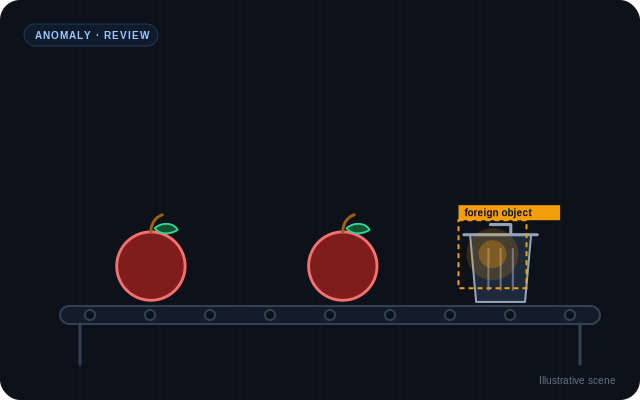
Flag visible foreign material — plastic, packaging pieces, stones, discolored product — on food conveyors so it can be removed before packing.
What can be checked
- Plastic and packaging fragments
- Stones and debris
- Discolored or defective product
What the team receives
- Alerts or reject signals
- Contamination statistics
What the solution does
Extra safety layer
Adds a visual check for foreign material to existing metal detection and X-ray systems; it does not replace them.
Non-metal items
Can see plastics that metal detectors miss.
Source records
Records the type, time and line position of each finding, which helps quality teams trace contamination back to its source.
The operational problem
Non-metallic contaminants such as plastic are hard to catch with traditional detectors.
How visual intelligence helps
Cameras watch product on the conveyor and flag items that look unlike the product — plastic, packaging, stones or discolored pieces. Flagged items are removed by rejectors or staff, and events show where contamination comes from.
Example visual workflow
- Cameras view product on the conveyor.
- Unusual items are detected.
- Rejectors or staff remove them.
- Events are logged.
Illustrative workflow — the actual pipeline is designed for each site during the PoC.
Edge deployment considerations
Detection runs at the conveyor with low latency to rejectors, alongside existing metal detection and X-ray systems.
How the solution is built
AI capabilities
The AI tasks this use case combines.
- Object Detection
Object detection finds and labels the objects in an image or video frame and marks each one with a bounding box.
- Visual Anomaly Detection
Visual anomaly detection learns what normal looks like and flags images, regions or events that deviate from it.
Visual inputs
Cameras and imaging that typically supply the video.
- Industrial and Machine Vision Cameras
Industrial and machine vision cameras capture sharp, consistent images at fixed positions with controlled lighting and triggering.
- Multispectral and Hyperspectral Cameras
Multispectral cameras capture several specific wavelength bands; hyperspectral cameras capture many narrow bands per pixel.
Deployment options
General approaches to evaluate, not tested hardware. Specific hardware is selected and validated for each project during the PoC.
- Edge AI Hardware Sizing
Sizing Edge AI hardware means matching compute, memory, power and enclosure to the real workload — the number of streams, resolution, frame rate, models and latency targets — under the site's environmental and installation constraints.
- Edge Deployment Architectures
Edge-first means processing video at or near where it is captured.
- Industrial and Ruggedized Edge AI Computers
Industrial Edge AI computers and ruggedized systems house AI-capable processors in enclosures built for factories, vehicles and outdoor sites — wide temperature ranges, vibration, dust and industrial power.
Practical factors to plan for
Real-world results depend as much on the environment and camera setup as on the model.
Site and setup
- Visibility. Only items visible on the surface can be detected.
- Product variety. Natural variation must be distinguished from contaminants.
Human review
Staff remove flagged items. Food safety systems such as metal detectors and X-ray remain in place.
Limitations & scope
- Hidden contaminants are not visible.
- Does not replace X-ray or metal detection.
Proof of Concept
Have a visual AI challenge? Let's prove it.
Share a video of what happens in your environment and describe the outcome you need. We review every request for technical feasibility, then agree the scope of a focused Proof of Concept (PoC) with you.
Example request: “We want to flag blue glove fragments on our poultry deboning conveyor.”
Every request is reviewed for technical feasibility. PoC scope, timing and terms are agreed individually.
Related topics
How this page connects to industries, use cases, AI tasks, input sources and deployment options.