Input SourceBeyond visible color
Multispectral and Hyperspectral Cameras
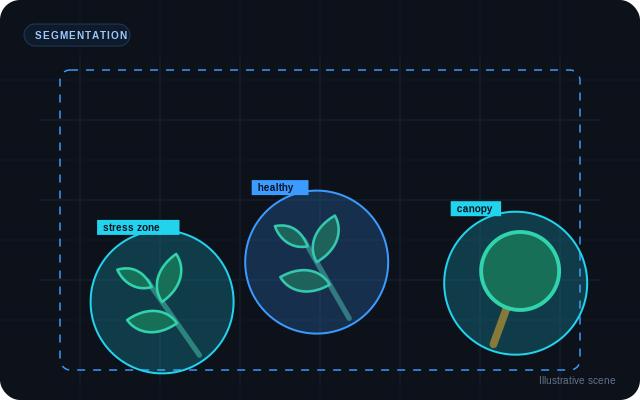
Multispectral cameras capture several specific wavelength bands; hyperspectral cameras capture many narrow bands per pixel. They reveal material and condition differences invisible to RGB cameras — in agriculture, environmental monitoring, sorting and inspection.
Where processing can run
- Onboard or ground-station processing. Aerial multispectral data is processed on capable drone compute, on ground stations or after the flight.
- Inline Edge processing. For sorting and inspection lines, an Edge computer processes selected bands in real time.
What this source enables
Vegetation and crop analysis
Highlighting differences in plant condition across fields for agronomic review.
Material discrimination
Distinguishing materials that look identical in visible color, for sorting or inspection.
Environmental observation
Mapping water, vegetation and surface changes from aerial imagery.
Seeing materials, not just color
Many materials and conditions differ in how they reflect light outside the visible range. Spectral cameras capture those differences, enabling analysis that RGB images cannot support.
Edge and Cloud balance
Spectral data is heavy. Practical architectures reduce it at the edge — by selecting bands or computing indices — and use Cloud resources only where large-scale processing is justified.
Expertise matters
Spectral signatures need interpretation. Projects combine imaging and AI expertise with domain experts in agronomy, materials or environmental science.
What to consider
Practical factors that determine which architecture and models are feasible.
Platform and mission
- Band selection. Multispectral cameras capture a few chosen bands; the right bands depend on the materials or conditions of interest.
- Data volume. Hyperspectral data cubes are large and computationally demanding; band selection or dimensionality reduction is often needed.
- Calibration. Reflectance calibration against reference targets and illumination is essential for consistent results.
Limitations & scope
- Spectral analysis depends on calibration, illumination and sensor characteristics; results are validated per setup.
- Hyperspectral processing is demanding; real-time Edge use usually requires reduced band sets.
- Interpretation of crop or material condition requires domain expertise.
Proof of Concept
Have a visual AI challenge? Let's prove it.
Share a video of what happens in your environment and describe the outcome you need. We review every request for technical feasibility, then agree the scope of a focused Proof of Concept (PoC) with you.
Example request: “We want to see whether multispectral drone images can highlight irrigation problems in our orchards.”
Every request is reviewed for technical feasibility. PoC scope, timing and terms are agreed individually.
Frequently asked questions
Do we need hyperspectral, or is multispectral enough?
Multispectral is sufficient when the relevant bands are known. Hyperspectral helps when exploring which wavelengths distinguish the materials of interest.
Can this run on a drone?
Multispectral cameras are common on drones. Onboard analysis is possible on capable platforms; many workflows process data after the flight.
Related topics
How this page connects to industries, use cases, AI tasks, input sources and deployment options.