Use CaseThermal visibility of hot processes
Furnace and Ladle Monitoring
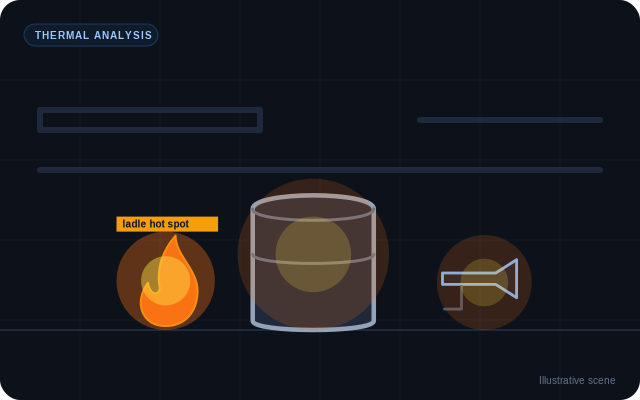
Observe furnaces, ladles, tapping and pouring with thermal and visual cameras to give operators safer visibility of hot processes and highlight unusual conditions.
What can be checked
- Unusual hot spots on ladle or furnace shells
- Pouring and tapping events
- Slag or splash conditions
What the team receives
- Thermal alerts for operators
- Event timeline of pouring operations
What the solution does
Remote visibility
Lets operators observe from a safer distance.
Refractory awareness
Highlights shell hot spots that may indicate wear.
Process records
Timestamps pouring, tapping and other process events from video, giving engineers a consistent record for process reviews.
The operational problem
Hot processes are dangerous to observe up close, and refractory wear can lead to serious incidents if not noticed.
How visual intelligence helps
Thermal cameras and analytics provide continuous visibility, highlighting unusual hot spots and recording process events.
Example visual workflow
- Thermal and visual cameras observe the process area.
- Models detect events and hot-spot patterns.
- Alerts and trends are shown to operators.
- Events are logged for maintenance and process review.
Illustrative workflow — the actual pipeline is designed for each site during the PoC.
Edge deployment considerations
Processing runs on ruggedized Edge computers in the melt shop, independent of external connectivity.
How the solution is built
AI capabilities
The AI tasks this use case combines.
- Action and Activity Recognition
Action recognition identifies short actions — picking, lifting, opening a door — while activity recognition describes longer sequences such as a loading operation or a procedure.
- Visual Anomaly Detection
Visual anomaly detection learns what normal looks like and flags images, regions or events that deviate from it.
Visual inputs
Cameras and imaging that typically supply the video.
- IP and Network Cameras
IP cameras stream digital video over standard networks and are the most common source for Edge AI video analytics.
- Thermal and Infrared Cameras
Thermal cameras image heat (long-wave infrared), while near-infrared cameras use invisible illumination to see in darkness.
Deployment options
General approaches to evaluate, not tested hardware. Specific hardware is selected and validated for each project during the PoC.
- Camera and VMS Integration
Most projects start with cameras that are already installed.
- Edge AI Hardware Sizing
Sizing Edge AI hardware means matching compute, memory, power and enclosure to the real workload — the number of streams, resolution, frame rate, models and latency targets — under the site's environmental and installation constraints.
- Edge Deployment Architectures
Edge-first means processing video at or near where it is captured.
- Industrial and Ruggedized Edge AI Computers
Industrial Edge AI computers and ruggedized systems house AI-capable processors in enclosures built for factories, vehicles and outdoor sites — wide temperature ranges, vibration, dust and industrial power.
Practical factors to plan for
Real-world results depend as much on the environment and camera setup as on the model.
Site and setup
- Thermal calibration. Emissivity and distance affect temperature readings.
- Camera protection. Cameras need cooling and protective windows.
Human review
Operators assess alerts using process knowledge and instrumentation. Analytics do not control the process.
Limitations & scope
- Thermal readings are indicative and do not replace process instrumentation.
- Smoke and steam can obscure views.
Proof of Concept
Have a visual AI challenge? Let's prove it.
Share a video of what happens in your environment and describe the outcome you need. We review every request for technical feasibility, then agree the scope of a focused Proof of Concept (PoC) with you.
Example request: “We want alerts for unusual hot spots on ladle shells as ladles pass our thermal camera.”
Every request is reviewed for technical feasibility. PoC scope, timing and terms are agreed individually.
Related topics
How this page connects to industries, use cases, AI tasks, input sources and deployment options.