IndustryIndustrial operations
Edge AI Video Intelligence for Manufacturing
Manufacturing sites already generate large volumes of visual data — from fixed cameras, inspection cameras and, increasingly, mobile platforms. EdgeTech designs video analytics that process this data on site to support safety, quality and operational decisions.
Common challenges
- Safety rules such as PPE and restricted zones need consistent attention across lines and shifts, which spot checks alone cannot provide.
- Visual quality checks are repetitive, and manual inspection results vary between operators and over long shifts.
- Blockages, equipment states and process deviations are often noticed only after they have affected output.
- Sending continuous high-resolution video off site is expensive and can conflict with data and security policies.
Typical visual sources
- Fixed and IP cameras covering production halls, line entrances and loading areas
- Industrial vision cameras at inspection points, often with controlled lighting
- Thermal cameras where heat is a meaningful signal, such as motors or process equipment
- Mobile robots or drones for inspecting large, elevated or hard-to-reach areas
Potential applications
PPE and safety compliance
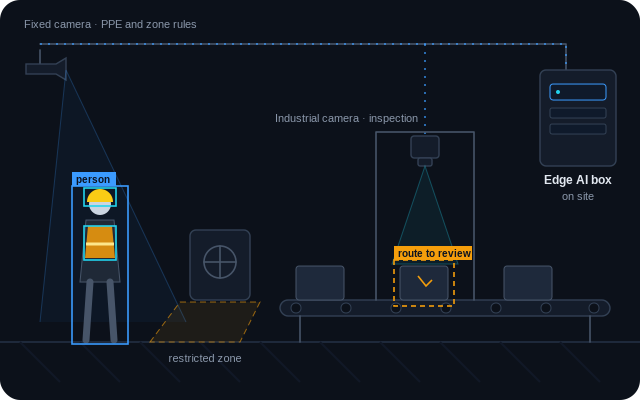
Check whether required protective equipment is worn in defined zones, and flag possible violations for a supervisor to review.
Restricted zones around machinery
Detect people entering hazardous areas around moving equipment, robot cells or forklift routes, using zone rules defined per camera.
Visual quality inspection
Classify or segment products and surfaces at inspection points to flag possible defects for confirmation by quality staff.
Equipment and process monitoring
Observe line activity, blockages, queues or equipment states to give operations teams earlier visibility of problems.
Docks and internal logistics
Monitor loading docks, pallet zones and routes where people and vehicles share space.
Smoke and flame awareness
Flag visual signs of smoke or flame as an additional layer of awareness — never as a replacement for certified fire detection.
Where video intelligence fits in a plant
Manufacturing is one of several industries where Edge AI video intelligence is relevant — and a useful example of why processing at the source matters. Production environments combine safety-critical activity, repetitive visual checks and equipment that changes state minute by minute. Much of this is already visible to cameras; the gap is turning that visual data into timely, reliable information.
The most valuable starting points are narrow, well-defined problems with a clear owner: PPE at a line entrance, people entering a robot cell, a recurring defect at one inspection station. Broad “monitor everything” goals are harder to validate and rarely the best first step.
From operational problem to architecture
A manufacturing project connects several decisions, and each is made for the specific site:
- Use case — the problem to solve, such as PPE compliance or quality inspection.
- AI tasks — the computer vision capabilities required, for example object detection or segmentation.
- Visual sources — existing fixed cameras, dedicated inspection cameras or mobile platforms.
- Compute hardware — an Edge AI computer sized for the number of streams and the models used.
- Deployment — Edge-only, or Edge with Cloud services where central reporting is needed.
For example, PPE monitoring at a line entrance might use object detection on an existing fixed camera, processed by an Edge AI computer in a nearby cabinet, with events sent to a supervisor dashboard on the local network. Another plant may need a different arrangement.
Why process on site
Processing next to the cameras keeps time-sensitive alerts local, reduces the bandwidth needed to move video, keeps footage on infrastructure the plant controls, and allows analysis to continue if the external network is unavailable.
Limitations & scope
- The applications above describe what Edge AI video intelligence can address. Feasibility and performance are confirmed for each site through assessment and a proof of concept.
- Results depend on camera placement, resolution, lighting, occlusion and how closely the training data matches the site.
- Video analytics supports, and does not replace, certified safety systems, machine guarding, fire detection or established quality procedures.
Proof of Concept
Have a visual AI challenge? Let's prove it.
Share a video of what happens in your environment and describe the outcome you need. We review every request for technical feasibility, then agree the scope of a focused Proof of Concept (PoC) with you.
Every request is reviewed for technical feasibility. PoC scope, timing and terms are agreed individually.
Frequently asked questions
Do we need to install new cameras?
Often existing fixed cameras can be evaluated first. Some applications, such as detailed quality inspection, usually need dedicated industrial cameras with controlled lighting. Suitability is assessed for each application.
Can video stay on our premises?
Yes. In an Edge-only deployment, video is processed and stored on site. Cloud services are added only if the project needs them, for example for multi-site dashboards.
How does a manufacturing project usually start?
With a short discussion of one well-defined operational problem, followed by a site and data assessment and a proof of concept on agreed sample footage before any wider rollout.
Related topics
How this page connects to industries, use cases, AI tasks, input sources and deployment options.
Use Cases
- Assembly Step Verification
- Asset Tracking and Monitoring
- Casting Defect Detection
- Composite Defect Inspection
- Conveyor Belt Monitoring
- Crane Lift Zone Monitoring
- Date and Lot Code Verification
- Dimensional Measurement from Images
- Equipment Monitoring
- Fabric Defect Detection
- Fastener and Rivet Inspection
- Fire and Smoke Detection
- Forklift and Pedestrian Proximity Awareness
- Furnace and Ladle Monitoring
- Glass and Bottle Defect Inspection
- Inventory Monitoring
- Label Inspection
- Loading and Unloading Monitoring
- Man-Down and Worker Fall Detection
- Manual Workstation Cycle Time Analysis
- Meter and Gauge Reading
- Missing Component Detection
- Object Pose Estimation for Robotics
- Packaging Inspection
- Part and Component Counting
- Part Orientation Detection
- PCB Inspection
- PPE Compliance Monitoring
- Product Detection and Verification
- Production Line and Process Monitoring
- Quality Inspection and Defect Detection
- Restricted Area Monitoring
- Robot Workspace Monitoring
- Serial Number and Part Marking Reading
- Steel and Metal Surface Inspection
- Surface Scratch and Cosmetic Defect Detection
- Tailgating Detection at Access Points
- Thermal Equipment Monitoring
- Tool Presence Verification
- Touchless Gesture Control
- Vision-Guided Bin Picking
- Visual Compliance Monitoring
- Weld Seam Inspection
- Wood and Lumber Defect Grading
- Working at Height Safety Awareness
- Workplace Safety Monitoring