Use CaseCracks, chips and inclusions in glass
Glass and Bottle Defect Inspection
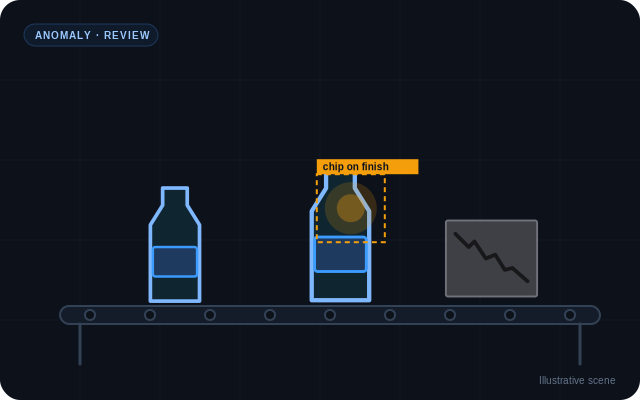
Inspect glass bottles, jars and flat glass for visible cracks, chips, inclusions, bubbles and deformations, supporting quality teams in glass production and filling.
What can be checked
- Cracks and chips on finish body and base
- Inclusions stones and bubbles
- Deformations and wall thickness indications
What the team receives
- Reject signal per container or panel
- Defect statistics per mold or line
What the solution does
Every item checked
Aims to inspect every container on the line; achievable speed depends on line rate, cameras and lighting and is confirmed in the PoC.
Mold feedback
Links defects to molds for faster correction.
Fewer escapes
Prevents dangerous glass defects reaching customers.
The operational problem
Glass defects can cause breakage, injuries and recalls, and inspecting transparent containers at line speed is difficult for people.
How visual intelligence helps
Multi-view cameras with special lighting inspect every container or panel; AI models classify defects and reject affected items, linking results to molds.
Example visual workflow
- Containers or panels pass inspection stations.
- Images from several views are analyzed.
- Defective items are rejected.
- Statistics are linked to molds and lines.
Illustrative workflow — the actual pipeline is designed for each site during the PoC.
Edge deployment considerations
Inspection runs at the line with direct control of reject mechanisms and keeps pace with production speed.
How the solution is built
AI capabilities
The AI tasks this use case combines.
- Defect Detection
Defect detection locates and classifies specific, known defect types — scratches, cracks, dents, contamination, missing features — in images of products or assets.
- Visual Anomaly Detection
Visual anomaly detection learns what normal looks like and flags images, regions or events that deviate from it.
Visual inputs
Cameras and imaging that typically supply the video.
- High-Speed Cameras
High-speed cameras capture hundreds or thousands of frames per second, revealing events too fast for standard cameras — on fast packaging lines, in machinery or in process analysis.
- Industrial and Machine Vision Cameras
Industrial and machine vision cameras capture sharp, consistent images at fixed positions with controlled lighting and triggering.
- Line-Scan Cameras
Line-scan cameras capture one line of pixels at a time and build an image as material moves past — ideal for continuous webs such as steel strip, fabric, paper, film and glass, and for large or cylindrical parts.
Deployment options
General approaches to evaluate, not tested hardware. Specific hardware is selected and validated for each project during the PoC.
- Edge AI Hardware Sizing
Sizing Edge AI hardware means matching compute, memory, power and enclosure to the real workload — the number of streams, resolution, frame rate, models and latency targets — under the site's environmental and installation constraints.
- Edge Deployment Architectures
Edge-first means processing video at or near where it is captured.
- Industrial and Ruggedized Edge AI Computers
Industrial Edge AI computers and ruggedized systems house AI-capable processors in enclosures built for factories, vehicles and outdoor sites — wide temperature ranges, vibration, dust and industrial power.
Practical factors to plan for
Real-world results depend as much on the environment and camera setup as on the model.
Site and setup
- Lighting. Transparent glass needs backlight, polarization and angled light to reveal defects.
- Mold traceability. Linking defects to molds requires reading mold numbers.
Human review
Quality staff review rejects and investigate recurring defects with production.
Limitations & scope
- Some internal stresses are not visible without special optics.
- Very fast lines need high-speed cameras and lighting.
Proof of Concept
Have a visual AI challenge? Let's prove it.
Share a video of what happens in your environment and describe the outcome you need. We review every request for technical feasibility, then agree the scope of a focused Proof of Concept (PoC) with you.
Example request: “We want to detect chips on the finish of returnable glass bottles before refilling.”
Every request is reviewed for technical feasibility. PoC scope, timing and terms are agreed individually.
Related topics
How this page connects to industries, use cases, AI tasks, input sources and deployment options.