Use CaseGait observation in walkways
Lameness Indicators in Livestock
Observe animal gait in walkways, for example after milking, to flag animals whose movement suggests they should be checked for lameness.
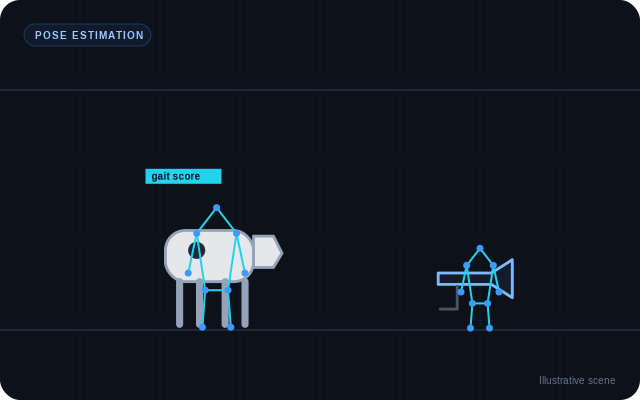
What can be checked
- Gait and back posture while walking
- Stride irregularities
- Changes over time per animal
What the team receives
- Indicator score per passage
- List of animals to check
What the solution does
Earlier checks
Flags animals before signs become obvious.
Daily observation
Observes every animal passage through the walkway, every day.
Trend data
Tracks gait indicators for each animal over days and weeks, so herd managers can see gradual changes and act early.
The operational problem
Lameness affects welfare and productivity, but manual mobility scoring takes time and is often done only occasionally, so changes are noticed late.
How visual intelligence helps
A side camera observes animals walking through a passage, and pose estimation measures gait and back posture. Animals whose indicators change are listed for a closer check by staff.
Example visual workflow
- A side camera records animals walking past.
- Pose keypoints are estimated.
- Gait indicators are calculated.
- Animals with changed indicators are listed for checks.
Illustrative workflow — the actual pipeline is designed for each site during the PoC.
Edge deployment considerations
An Edge device at the walkway processes video locally and links results to animal IDs from existing tag readers, so the list fits into daily routines.
How the solution is built
AI capabilities
The AI tasks this use case combines.
- Object Tracking and Multi-Object Tracking
Object tracking links detections of the same object across consecutive video frames and assigns each one a persistent ID.
- Pose Estimation
Pose estimation locates keypoints — such as shoulders, elbows, knees or the corners of an object — and connects them into a skeleton or structure.
Visual inputs
Cameras and imaging that typically supply the video.
- Depth, Stereo and 3D Cameras
Depth cameras measure distance to every point in view, using stereo vision, structured light or time-of-flight.
- IP and Network Cameras
IP cameras stream digital video over standard networks and are the most common source for Edge AI video analytics.
Deployment options
General approaches to evaluate, not tested hardware. Specific hardware is selected and validated for each project during the PoC.
- Camera and VMS Integration
Most projects start with cameras that are already installed.
- Edge AI Hardware Sizing
Sizing Edge AI hardware means matching compute, memory, power and enclosure to the real workload — the number of streams, resolution, frame rate, models and latency targets — under the site's environmental and installation constraints.
- Edge Deployment Architectures
Edge-first means processing video at or near where it is captured.
- Industrial and Ruggedized Edge AI Computers
Industrial Edge AI computers and ruggedized systems house AI-capable processors in enclosures built for factories, vehicles and outdoor sites — wide temperature ranges, vibration, dust and industrial power.
Practical factors to plan for
Real-world results depend as much on the environment and camera setup as on the model.
Site and setup
- Identification. Linking scores to animals needs tag readers or IDs.
- Walkway setup. A side view of a straight walkway is needed.
Human review
Staff and veterinarians check flagged animals. Scores are indicators only.
Limitations & scope
- Not a veterinary diagnosis.
- Crowded walkways reduce measurement quality.
Proof of Concept
Have a visual AI challenge? Let's prove it.
Share a video of what happens in your environment and describe the outcome you need. We review every request for technical feasibility, then agree the scope of a focused Proof of Concept (PoC) with you.
Example request: “We want a daily list of cows whose gait changed, from a camera at the milking parlor exit.”
Every request is reviewed for technical feasibility. PoC scope, timing and terms are agreed individually.
Related topics
How this page connects to industries, use cases, AI tasks, input sources and deployment options.