Use CasePopulated board defects
PCB Inspection
Inspect populated printed circuit boards for missing, misaligned or wrong components and visible defects, complementing automated optical inspection with AI-based review.
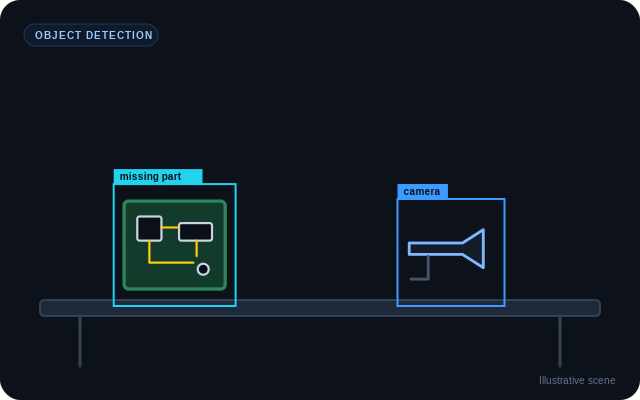
What can be checked
- Missing or extra components
- Shifted or rotated components
- Visible board damage or contamination
What the team receives
- Pass or review decision per board
- Annotated defect images
What the solution does
Fewer false calls
Classifies AOI images to separate real defects from noise.
Variant support
Adapts to new board variants with limited setup.
Line-side processing
Is sized to fit within the line's cycle time; the required hardware is confirmed against your takt time during the PoC.
The operational problem
Automated optical inspection catches many defects but also creates false calls that operators must review. Frequent product changes make rule-based programs costly to maintain.
How visual intelligence helps
AI models classify board images and flag real defects, either directly or as a second opinion on AOI calls. Operators review fewer boards and focus on real issues.
Example visual workflow
- A board passes under the camera after placement or reflow.
- The image is analyzed for component and board defects.
- Boards are passed or routed to review.
- Results are logged with the board serial.
Illustrative workflow — the actual pipeline is designed for each site during the PoC.
Edge deployment considerations
Models run on an Edge computer at the line, receiving images from cameras or AOI equipment and returning decisions within the cycle time.
How the solution is built
AI capabilities
The AI tasks this use case combines.
- Defect Detection
Defect detection locates and classifies specific, known defect types — scratches, cracks, dents, contamination, missing features — in images of products or assets.
- Object Detection
Object detection finds and labels the objects in an image or video frame and marks each one with a bounding box.
Visual inputs
Cameras and imaging that typically supply the video.
- Industrial and Machine Vision Cameras
Industrial and machine vision cameras capture sharp, consistent images at fixed positions with controlled lighting and triggering.
Deployment options
General approaches to evaluate, not tested hardware. Specific hardware is selected and validated for each project during the PoC.
- Edge AI Hardware Sizing
Sizing Edge AI hardware means matching compute, memory, power and enclosure to the real workload — the number of streams, resolution, frame rate, models and latency targets — under the site's environmental and installation constraints.
- Edge Deployment Architectures
Edge-first means processing video at or near where it is captured.
- Industrial and Ruggedized Edge AI Computers
Industrial Edge AI computers and ruggedized systems house AI-capable processors in enclosures built for factories, vehicles and outdoor sites — wide temperature ranges, vibration, dust and industrial power.
Practical factors to plan for
Real-world results depend as much on the environment and camera setup as on the model.
Site and setup
- Optics. Small components need high-resolution cameras and controlled lighting.
- Product variety. Each board variant needs reference data or a generic model.
Human review
Operators review flagged boards at a repair station. Final pass decisions follow the quality procedure.
Limitations & scope
- Hidden joints such as BGAs require X-ray inspection.
- Performance must be measured per board family.
Proof of Concept
Have a visual AI challenge? Let's prove it.
Share a video of what happens in your environment and describe the outcome you need. We review every request for technical feasibility, then agree the scope of a focused Proof of Concept (PoC) with you.
Example request: “We want to review AOI images of our power boards to reduce false calls at the repair station.”
Every request is reviewed for technical feasibility. PoC scope, timing and terms are agreed individually.
Frequently asked questions
Can this work with our AOI machine?
Often AOI images can be exported and reviewed by an AI model. Integration depends on the machine's interfaces.
Related topics
How this page connects to industries, use cases, AI tasks, input sources and deployment options.