Use CaseProducts in the right place
Planogram Compliance
Compare shelf images with planograms to highlight missing, misplaced or wrongly faced products, supporting merchandising teams.
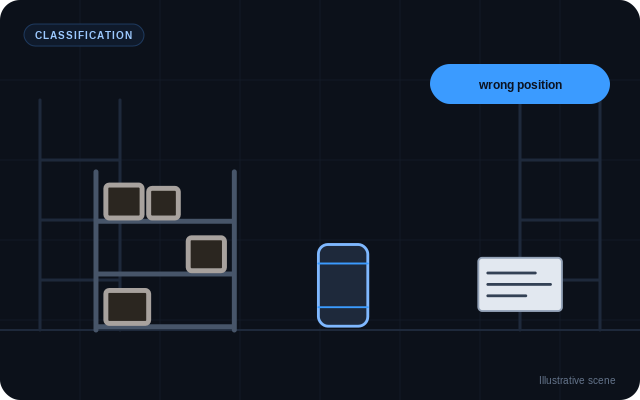
What can be checked
- Products in wrong positions
- Missing facings
- Price label mismatches
What the team receives
- Compliance scores
- Correction lists
What the solution does
Faster audits
Reduces time spent on manual shelf audits.
Compliance insight
Measures how well planograms are executed across stores.
Corrections
Creates prioritized correction lists for merchandisers.
The operational problem
Planogram execution varies between stores and manual audits are slow, so headquarters has little visibility of what is actually on the shelf.
How visual intelligence helps
Shelf images are analyzed to recognize products and their positions, which are compared with the digital planogram. Differences become correction lists for merchandisers.
Example visual workflow
- Shelf images are captured.
- Products are recognized.
- Positions are compared with planograms.
- Correction lists are created.
Illustrative workflow — the actual pipeline is designed for each site during the PoC.
Edge deployment considerations
Recognition can run on a handheld device or a store Edge server; compliance results are aggregated centrally for category teams.
How the solution is built
AI capabilities
The AI tasks this use case combines.
- Image and Object Classification
Classification assigns a label to a whole image or to an individual object crop — good or defective, running or stopped, product variant A or B.
- Object Detection
Object detection finds and labels the objects in an image or video frame and marks each one with a bounding box.
Visual inputs
Cameras and imaging that typically supply the video.
- Mobile Device Cameras
Smartphones and tablets put capable cameras and processors in the hands of field teams.
- Mobile Robots and AMRs
Mobile robots — autonomous mobile robots (AMRs), quadrupeds and inspection robots — carry cameras through facilities and sites on repeatable routes.
Deployment options
General approaches to evaluate, not tested hardware. Specific hardware is selected and validated for each project during the PoC.
- Edge AI Hardware Sizing
Sizing Edge AI hardware means matching compute, memory, power and enclosure to the real workload — the number of streams, resolution, frame rate, models and latency targets — under the site's environmental and installation constraints.
- Edge Deployment Architectures
Edge-first means processing video at or near where it is captured.
- Standalone Edge AI Devices
Standalone Edge AI devices are compact, self-contained units — AI boxes or smart cameras — that process video locally at a single location.
Practical factors to plan for
Real-world results depend as much on the environment and camera setup as on the model.
Site and setup
- Product recognition. Requires product image data.
- Planogram data. Planograms must be digital.
Human review
Merchandisers verify suggested corrections on the shelf before changing products.
Limitations & scope
- Similar packaging may be confused.
- Requires current planograms.
Proof of Concept
Have a visual AI challenge? Let's prove it.
Share a video of what happens in your environment and describe the outcome you need. We review every request for technical feasibility, then agree the scope of a focused Proof of Concept (PoC) with you.
Example request: “We want planogram compliance scores for our beverage aisle from handheld images.”
Every request is reviewed for technical feasibility. PoC scope, timing and terms are agreed individually.
Related topics
How this page connects to industries, use cases, AI tasks, input sources and deployment options.