IndustryStores, back rooms and distribution
Edge AI Video Intelligence for Retail
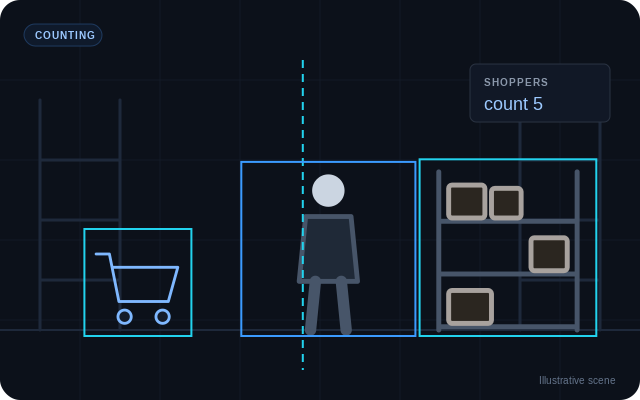
Retail operations depend on stocked shelves, smooth customer flow and efficient back-of-store processes. Edge AI video intelligence can support shelf visibility, queue and occupancy monitoring and loading-bay activity — with a privacy-conscious, aggregate approach.
Common challenges
- Out-of-stock shelves are discovered late, during manual walks.
- Checkout queues build quickly at peak times.
- Store occupancy and visitor flow are hard to measure consistently.
- Back-of-store deliveries and stockrooms are busy and poorly supervised.
Typical visual sources
- Existing CCTV and IP cameras in stores and stockrooms
- Shelf-facing cameras or cameras on mobile robots
- Cameras at loading bays and receiving areas
Potential applications
Shelf and stock visibility
Estimate empty or low shelf areas so staff can replenish before customers notice.
Queue monitoring
Measure queue length and waiting time at checkouts and service points to support staffing.
Occupancy and flow
Count people entering and leaving zones as anonymous, aggregate statistics.
Receiving and loading
Monitor delivery activity, dwell time and safety in loading and receiving areas.
Operations, not surveillance
Retail video intelligence is most useful when it helps run the store better: shelves stocked, queues short, deliveries handled safely. Designing for anonymous, aggregate outputs keeps the focus on operations and reduces privacy risk.
Edge processing in stores
Processing in the store keeps customer footage on site and sends only counts and events to central dashboards. This also reduces bandwidth for chains with many locations.
Questions to answer early
- Which store process has the clearest business impact?
- What privacy and signage requirements apply in your markets?
- How will staff receive and act on alerts?
Limitations & scope
- Retail analytics must respect customer privacy; aggregate counts are preferred, and face recognition is out of scope.
- Shelf analysis depends on camera angle, shelf layout and product packaging; planogram matching needs per-store setup.
- Customer-facing video use must follow local regulation, signage requirements and your privacy policy.
Proof of Concept
Have a visual AI challenge? Let's prove it.
Share a video of what happens in your environment and describe the outcome you need. We review every request for technical feasibility, then agree the scope of a focused Proof of Concept (PoC) with you.
Example request: “We want an alert when more than five people are waiting at any checkout, using our ceiling cameras.”
Every request is reviewed for technical feasibility. PoC scope, timing and terms are agreed individually.
Frequently asked questions
Do you identify individual shoppers?
No. Retail use cases here are designed around anonymous, aggregate information such as counts and queue lengths. Identification of individuals is not part of these solutions.
Can existing store cameras be used?
Often for queues and occupancy. Shelf monitoring usually needs dedicated shelf-facing or robot-mounted cameras for adequate resolution.
Related topics
How this page connects to industries, use cases, AI tasks, input sources and deployment options.
Use Cases
- ATM Tamper Awareness
- Brand and Logo Exposure Measurement
- Inventory Monitoring
- Loading and Unloading Monitoring
- Loitering and Dwell Detection
- Occupancy Monitoring
- Order Packing Verification
- Parking Monitoring
- People Counting
- Planogram Compliance
- Price Tag and Shelf Label Verification
- Queue Monitoring
- Returns Inspection
- Self-Checkout Scan Awareness
- Shelf Availability Monitoring
- Smart Vending and Cooler Product Recognition
- Store Traffic Heat Maps
- Touchless Gesture Control
- Video Anonymization and Privacy Redaction