Input SourceQuadrupeds, AMRs and inspection robots
Mobile Robots and AMRs
Mobile robots — autonomous mobile robots (AMRs), quadrupeds and inspection robots — carry cameras through facilities and sites on repeatable routes. Some offer optional onboard compute for AI; others stream to an external Edge device. The architecture depends on the platform.
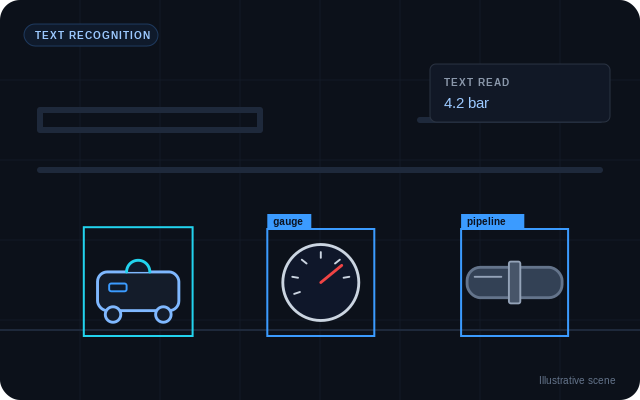
Where processing can run
- Onboard AI compute. Models run on compute carried by the robot — where the platform offers a suitable option — producing results during the mission.
- Streaming to an Edge device. The robot streams video over the site network to an Edge AI computer that runs the models.
- Post-mission analysis. Imagery is uploaded after the route and analyzed on site or centrally.
What this source enables
Autonomous inspection rounds
Capturing gauges, equipment, leaks or thermal signatures on repeatable routes through plants and sites.
Logistics and inventory capture
Scanning racks and shelves with cameras on AMRs that already move through warehouses.
Access to hazardous areas
Bringing cameras into areas that are unsafe or inconvenient for people to visit frequently.
Robots as mobile visual sources
A robot is a visual input source that moves. Its value lies in repeatable routes and access to places fixed cameras do not cover. Its compute options are a separate question from its cameras.
Choosing where processing runs
If results are needed during the mission and the platform offers suitable compute, models can run onboard. Otherwise, streaming to an Edge device or post-mission analysis may be simpler and allow larger models.
Compatibility is verified per platform
Hardware statements on this page are limited to what manufacturers document, listed below with their sources. Optional configurations are described as options, not standard equipment.
What to consider
Practical factors that determine which architecture and models are feasible.
Platform and mission
- Onboard compute is often optional. Many robots include basic computers for navigation; additional AI compute is frequently an optional configuration and varies by model.
- Software access. Running custom models requires access to the robot's cameras and compute through a supported SDK or interface.
- Repeatable routes. Robots follow repeatable paths, making image comparisons over time more reliable than handheld capture.
- Payload and power. Additional cameras and compute affect payload, battery life and mission duration.
Hardware references and compatibility status
Statements are limited to what manufacturers document officially. Listing a product does not imply a partnership with EdgeTech or a completed integration; compatibility is verified for each project.
| Platform | What the manufacturer states | Status | Source |
|---|---|---|---|
| Unitree Go2 | A high-computing-power module is offered as an optional configuration on selected Go2 versions; Unitree cites options such as Orin (40–100 TOPS) from multiple brands and models.Note: Not standard equipment. The exact module depends on the configuration ordered; Unitree advises contacting them for details. | Manufacturer-supported option | Official pageChecked 2026-11-21 |
| Unitree B2 | Standard configuration includes Intel Core i5 (platform functions) and Intel Core i7 (user development); optional configurations include Intel Core i7 or Orin NX, up to three devices.Note: Orin NX is an option, not standard. Integration effort for custom vision workloads must be assessed per project. | Manufacturer-supported option | Official pageChecked 2026-11-21 |
Limitations & scope
- Not every robot includes onboard AI compute; optional modules differ by model and must be confirmed with the manufacturer.
- Integration with a robot's software platform is verified per model; listed products do not imply a completed integration.
- Robot operation in shared spaces must follow applicable safety standards and site rules.
Proof of Concept
Have a visual AI challenge? Let's prove it.
Share a video of what happens in your environment and describe the outcome you need. We review every request for technical feasibility, then agree the scope of a focused Proof of Concept (PoC) with you.
Example request: “We want a quadruped robot to read gauges on its inspection route and flag readings outside range.”
Every request is reviewed for technical feasibility. PoC scope, timing and terms are agreed individually.
Frequently asked questions
Do all robot dogs include an NVIDIA Jetson?
No. For example, Unitree describes a high-computing-power module for the Go2 as an optional configuration on selected versions, and lists Orin NX as an optional configuration for the B2. Standard configurations differ by model.
Can we use the robot we already have?
Possibly. We check camera access, compute options and the software interface of your platform during project assessment.
Related topics
How this page connects to industries, use cases, AI tasks, input sources and deployment options.
Industries
- Edge AI Video Intelligence for Agriculture
- Edge AI Video Intelligence for Energy
- Edge AI Video Intelligence for Healthcare Facilities
- Edge AI Video Intelligence for Oil and Gas
- Edge AI Video Intelligence for Retail
- Edge AI Video Intelligence for Robotics and Automation
- Edge AI Video Intelligence for Warehousing
Use Cases
- AMR Obstacle Perception
- Asset Tracking and Monitoring
- Crop Row Detection for Machine Guidance
- Drone-Based Inventory Scanning
- Industrial Visual Inspection
- Inventory Monitoring
- Meter and Gauge Reading
- Planogram Compliance
- Price Tag and Shelf Label Verification
- Ripeness and Harvest Readiness
- Shelf Availability Monitoring