Use CaseUnwanted items in streams and bins
Recycling Contamination Detection
Flag visible contamination — wrong materials, bags, hazardous items — in recycling streams, collection loads and bins, so it can be removed or addressed.
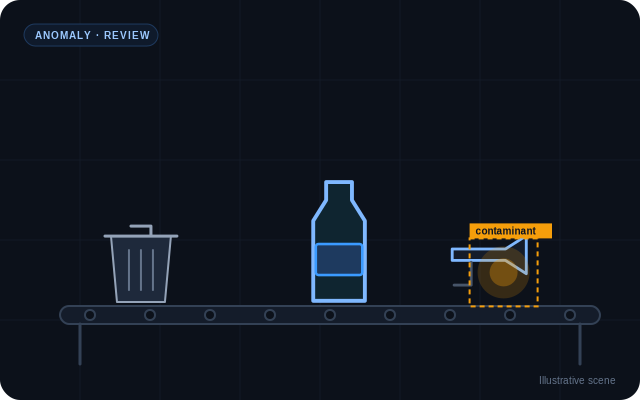
What can be checked
- Wrong materials in a stream
- Plastic bags and film
- Visible hazardous items such as batteries
What the team receives
- Contamination alerts with images
- Contamination rates
What the solution does
Purer output
Detects contaminants such as plastic film, textiles and wrong materials, so they can be removed before baling.
Customer feedback
Links contamination rates to collection routes and areas, which supports targeted resident education campaigns.
Hazard awareness
Flags visible batteries and other hazardous items in waste streams.
The operational problem
Contamination lowers the value of recycled material and can damage equipment. Problems are often discovered only when bales are rejected.
How visual intelligence helps
Cameras on lines or collection vehicles detect visible contaminants such as bags, film and batteries. Rates are recorded per stream, route or customer so teams can remove items or target education.
Example visual workflow
- Cameras view the stream or tipping point.
- Contaminants are detected.
- Alerts and rates are recorded.
- Staff act on results.
Illustrative workflow — the actual pipeline is designed for each site during the PoC.
Edge deployment considerations
Edge processing on vehicles or at lines keeps latency low and avoids uploading continuous video, which also limits privacy exposure on public streets.
How the solution is built
AI capabilities
The AI tasks this use case combines.
- Object Detection
Object detection finds and labels the objects in an image or video frame and marks each one with a bounding box.
- Visual Anomaly Detection
Visual anomaly detection learns what normal looks like and flags images, regions or events that deviate from it.
Visual inputs
Cameras and imaging that typically supply the video.
- Industrial and Machine Vision Cameras
Industrial and machine vision cameras capture sharp, consistent images at fixed positions with controlled lighting and triggering.
- Vehicle-Mounted Cameras
Cameras on trucks, rail vehicles, forklifts, buses and service vehicles capture visual data while moving — for road and rail inspection, operational safety and fleet operations.
Deployment options
General approaches to evaluate, not tested hardware. Specific hardware is selected and validated for each project during the PoC.
- Edge AI Hardware Sizing
Sizing Edge AI hardware means matching compute, memory, power and enclosure to the real workload — the number of streams, resolution, frame rate, models and latency targets — under the site's environmental and installation constraints.
- Edge Deployment Architectures
Edge-first means processing video at or near where it is captured.
- Industrial and Ruggedized Edge AI Computers
Industrial Edge AI computers and ruggedized systems house AI-capable processors in enclosures built for factories, vehicles and outdoor sites — wide temperature ranges, vibration, dust and industrial power.
- Standalone Edge AI Devices
Standalone Edge AI devices are compact, self-contained units — AI boxes or smart cameras — that process video locally at a single location.
Practical factors to plan for
Real-world results depend as much on the environment and camera setup as on the model.
Site and setup
- Item size. Small items such as batteries are hard to see.
- Public data. Collection vehicle cameras may capture people.
Human review
Staff remove contaminants or follow up with customers. Images are handled per privacy rules.
Limitations & scope
- Hidden contaminants cannot be detected.
- Battery detection is best-effort.
Proof of Concept
Have a visual AI challenge? Let's prove it.
Share a video of what happens in your environment and describe the outcome you need. We review every request for technical feasibility, then agree the scope of a focused Proof of Concept (PoC) with you.
Example request: “We want to flag plastic bags in our paper stream before the screen.”
Every request is reviewed for technical feasibility. PoC scope, timing and terms are agreed individually.
Related topics
How this page connects to industries, use cases, AI tasks, input sources and deployment options.