Input SourceTrucks, rail, forklifts and service fleets
Vehicle-Mounted Cameras
Cameras on trucks, rail vehicles, forklifts, buses and service vehicles capture visual data while moving — for road and rail inspection, operational safety and fleet operations. Processing onboard keeps results available without constant connectivity.
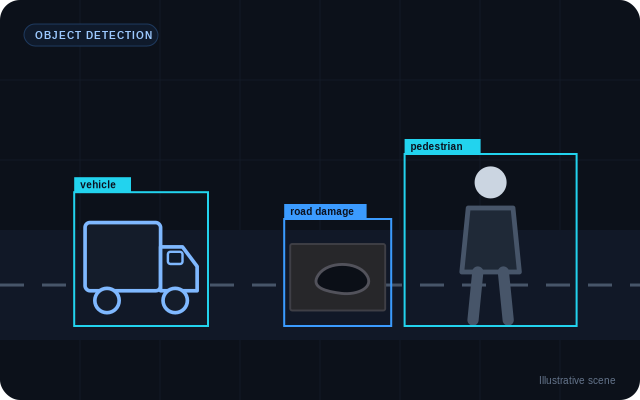
Where processing can run
- Onboard Edge computer. A ruggedized Edge AI computer in the vehicle analyzes video and stores or transmits results.
- Store and forward. Video or results are stored onboard and uploaded when the vehicle returns to a depot or connectivity is available.
- Hybrid. Time-critical alerts are produced onboard; detailed analysis runs centrally on uploaded data.
What this source enables
Mobile inspection
Capturing road surfaces, rail infrastructure, tunnels or roadside assets while vehicles operate.
Forklift and vehicle safety
Detecting pedestrians near forklifts or industrial vehicles as an awareness aid for drivers.
Fleet operations data
Producing operational events such as stops, loading activity or route conditions.
Visual data on the move
Vehicles cover large areas as part of normal operations. Cameras on them can collect visual data for inspection and safety without dedicated survey trips.
Processing onboard
Connectivity along routes is unreliable and video volumes are large. Onboard Edge processing makes results available immediately and reduces how much data must be uploaded.
Linking images to location
For inspection, every finding needs a location. Integrating GPS, odometry or track data with video is part of the architecture from the start.
What to consider
Practical factors that determine which architecture and models are feasible.
Platform and mission
- Vibration and environment. Cameras and compute must withstand vibration, temperature changes, dust and moisture.
- Power. Onboard compute draws from the vehicle's electrical system, which limits available power.
- Motion and speed. Vehicle speed affects motion blur and the resolution needed to capture details.
- Location data. Linking detections to GPS, odometry or track position is essential for inspection use cases.
Limitations & scope
- Driver-assistance and collision-avoidance functions are safety-critical and require certified systems; video analytics here are awareness aids.
- Recording public roads raises privacy considerations, including faces and number plates.
- Hardware must be rated for vehicle conditions; compatibility is confirmed per vehicle type.
Proof of Concept
Have a visual AI challenge? Let's prove it.
Share a video of what happens in your environment and describe the outcome you need. We review every request for technical feasibility, then agree the scope of a focused Proof of Concept (PoC) with you.
Example request: “We want to detect pedestrians near our forklifts from a rear camera and warn the driver.”
Every request is reviewed for technical feasibility. PoC scope, timing and terms are agreed individually.
Frequently asked questions
Can processing happen without mobile connectivity?
Yes. Onboard Edge processing produces results locally; data can be uploaded later when connectivity is available.
Can this warn forklift drivers about pedestrians?
Camera-based pedestrian awareness for forklifts is feasible as a driver aid. It supplements, and does not replace, certified safety systems and procedures.
Related topics
How this page connects to industries, use cases, AI tasks, input sources and deployment options.
Industries
- Edge AI Video Intelligence for Agriculture
- Edge AI Video Intelligence for Airports
- Edge AI Video Intelligence for Construction
- Edge AI Video Intelligence for Infrastructure
- Edge AI Video Intelligence for Logistics
- Edge AI Video Intelligence for Mining
- Edge AI Video Intelligence for Ports and Maritime
- Edge AI Video Intelligence for Recycling and Waste Management
- Edge AI Video Intelligence for Smart Cities
- Edge AI Video Intelligence for Transportation and Rail
- Edge AI Video Intelligence for Warehousing
Use Cases
- Asset Tracking and Monitoring
- Bridge and Tunnel Inspection Support
- Crack Detection on Concrete and Structures
- Crane Lift Zone Monitoring
- Crop Row Detection for Machine Guidance
- Driver Fatigue and Distraction Monitoring
- Fruit Counting and Yield Estimation
- Graffiti and Vandalism Detection
- Heavy Vehicle Proximity Awareness
- Industrial Visual Inspection
- Inventory Monitoring
- Litter and Illegal Dumping Detection
- Plant Stand and Emergence Counting
- Pothole and Road Damage Detection
- Rack Damage Detection
- Railway Track Inspection
- Recycling Contamination Detection
- Streetlight Outage Detection
- Traffic Monitoring
- Traffic Sign and Road Asset Inventory
- Vegetation Encroachment Monitoring
- Video Anonymization and Privacy Redaction
- Weed Detection for Targeted Treatment