IndustrySorting, collection and processing
Edge AI Video Intelligence for Recycling and Waste Management
Recycling and waste operations handle mixed, unpredictable material streams. Edge AI video intelligence can support material identification for sorting, contamination detection, bin fill monitoring and safety around heavy equipment.
Common challenges
- Mixed material streams are hard to sort accurately at speed.
- Contamination reduces the value of recycled material.
- Collection routes run whether bins are full or not.
- Heavy equipment and people share busy yards.
Typical visual sources
- Cameras over sorting conveyors
- Cameras on collection vehicles
- Fixed cameras at bins, bunkers and tipping floors
Potential applications
Material identification
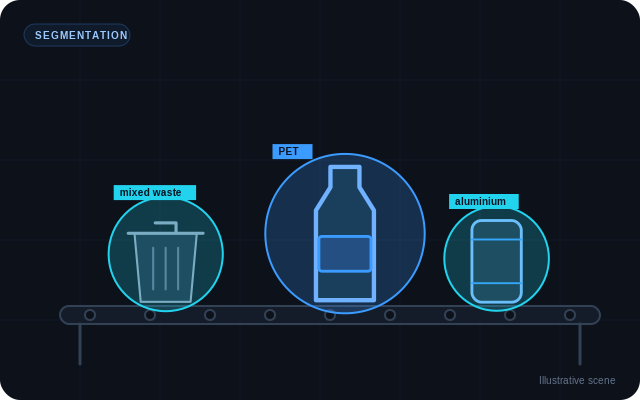
Classify visible materials on conveyors to support sorting decisions.
Contamination detection
Flag unwanted items in recycling streams or collection loads.
Fill monitoring
Estimate bin and bunker fill levels to plan collection.
Yard safety
Detect people near loaders and moving equipment.
Where video intelligence fits
Recycling depends on knowing what is in a material stream. Edge AI can measure and classify visible material continuously, informing sorting and contamination decisions.
Typical Edge architecture
Edge computers beside conveyors or on vehicles analyze imagery locally and share composition data and events with operations systems.
Questions to answer early
- Which material or contamination issue costs the most?
- Where in the process can cameras see the material clearly?
- Which equipment or systems would act on results?
Limitations & scope
- Visual identification cannot determine material composition that is not visible.
- Dirty, overlapping items reduce accuracy on conveyors.
- Actuation of sorting equipment requires integration with machine suppliers.
Proof of Concept
Have a visual AI challenge? Let's prove it.
Share a video of what happens in your environment and describe the outcome you need. We review every request for technical feasibility, then agree the scope of a focused Proof of Concept (PoC) with you.
Example request: “We want to measure how much film plastic contaminates our paper stream on the sorting line.”
Every request is reviewed for technical feasibility. PoC scope, timing and terms are agreed individually.
Frequently asked questions
Can vision replace optical sorters?
Not necessarily. It can complement existing sorters or provide data on stream composition.
Can collection trucks detect contamination?
Cameras on trucks can flag visible contamination in bins being emptied, subject to privacy rules on public streets.
Related topics
How this page connects to industries, use cases, AI tasks, input sources and deployment options.