Use CaseCondition grading of returned items
Returns Inspection
Capture returned items and support visual grading of condition — damage, missing parts, signs of use — so returns teams can process items faster and more consistently.
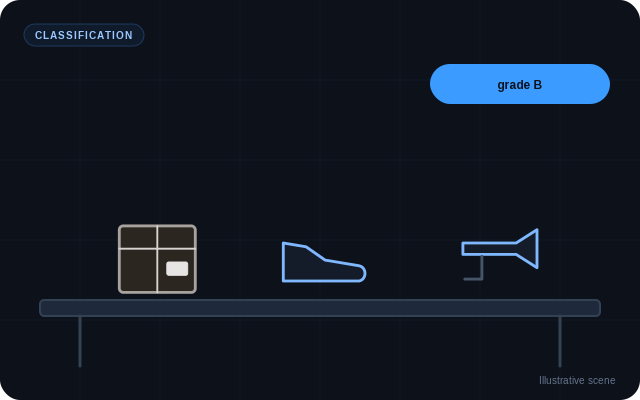
What can be checked
- Visible damage and stains
- Missing parts or packaging
- Signs of use
What the team receives
- Suggested grade with images
- Returns record
What the solution does
Faster processing
Captures and pre-classifies returned items at the grading station, helping staff decide faster whether to restock, refurbish or discard.
Consistency
Applies the same condition criteria for every returned item, regardless of who is working at the grading station.
Evidence
Stores images of each return's condition, which supports decisions on refunds and resolving disputes with customers or carriers.
The operational problem
Returns volumes are high and grading is subjective, which slows processing and delays resale. Different staff grade similar items differently, affecting refunds and stock value.
How visual intelligence helps
Images from a capture booth are analyzed for condition indicators, and staff confirm a suggested grade.
Example visual workflow
- The item is placed in a capture booth.
- Images are analyzed for condition indicators.
- A grade is suggested.
- Staff confirm and route the item.
Illustrative workflow — the actual pipeline is designed for each site during the PoC.
Edge deployment considerations
Analysis runs on a computer at the returns center, so images are processed at the bench without upload delays. Grades and images are stored in the returns system with the order reference.
How the solution is built
AI capabilities
The AI tasks this use case combines.
- Defect Detection
Defect detection locates and classifies specific, known defect types — scratches, cracks, dents, contamination, missing features — in images of products or assets.
- Image and Object Classification
Classification assigns a label to a whole image or to an individual object crop — good or defective, running or stopped, product variant A or B.
Visual inputs
Cameras and imaging that typically supply the video.
- Industrial and Machine Vision Cameras
Industrial and machine vision cameras capture sharp, consistent images at fixed positions with controlled lighting and triggering.
- Mobile Device Cameras
Smartphones and tablets put capable cameras and processors in the hands of field teams.
Deployment options
General approaches to evaluate, not tested hardware. Specific hardware is selected and validated for each project during the PoC.
- Edge AI Hardware Sizing
Sizing Edge AI hardware means matching compute, memory, power and enclosure to the real workload — the number of streams, resolution, frame rate, models and latency targets — under the site's environmental and installation constraints.
- Edge Deployment Architectures
Edge-first means processing video at or near where it is captured.
- Industrial and Ruggedized Edge AI Computers
Industrial Edge AI computers and ruggedized systems house AI-capable processors in enclosures built for factories, vehicles and outdoor sites — wide temperature ranges, vibration, dust and industrial power.
- Standalone Edge AI Devices
Standalone Edge AI devices are compact, self-contained units — AI boxes or smart cameras — that process video locally at a single location.
Practical factors to plan for
Real-world results depend as much on the environment and camera setup as on the model.
Site and setup
- Product range. Grading criteria differ per category.
- Capture booth. Consistent lighting improves grading.
Human review
Returns staff confirm the grade and disposition. Refund decisions follow company policy.
Limitations & scope
- Functional defects cannot be seen.
- Category-specific criteria require training data.
Proof of Concept
Have a visual AI challenge? Let's prove it.
Share a video of what happens in your environment and describe the outcome you need. We review every request for technical feasibility, then agree the scope of a focused Proof of Concept (PoC) with you.
Example request: “We want to suggest a condition grade for returned shoes from images taken at our returns bench.”
Every request is reviewed for technical feasibility. PoC scope, timing and terms are agreed individually.
Related topics
How this page connects to industries, use cases, AI tasks, input sources and deployment options.