Use CaseAnonymous movement patterns in stores
Store Traffic Heat Maps
Create anonymous heat maps and dwell statistics of customer movement in stores to inform layouts, staffing and promotions.
What can be checked
- Movement paths
- Dwell zones
- Visitor counts
What the team receives
- Heat maps
- Dwell statistics
What the solution does
Layout insight
Shows how customers move through the store.
Promotion evaluation
Measures how promotions change visits and dwell in a zone.
Staffing support
Aligns staff presence with busy zones and times.
The operational problem
Retailers make layout and staffing decisions with little data on how customers actually move through the store.
How visual intelligence helps
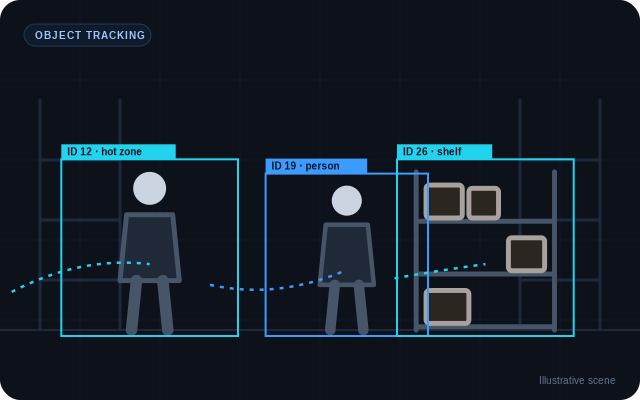
Ceiling cameras track movement anonymously and aggregate it into heat maps, dwell times and zone visit counts.
Example visual workflow
- Cameras observe the store.
- People are tracked anonymously.
- Heat maps are generated.
- Teams review.
Illustrative workflow — the actual pipeline is designed for each site during the PoC.
Edge deployment considerations
Tracking runs on a store Edge device and only aggregated statistics leave the store; no identities are stored.
How the solution is built
AI capabilities
The AI tasks this use case combines.
- Counting and Measurement
Counting and measurement convert detections, tracks and masks into quantities — how many objects, how long they stayed, how big they are, how full an area is.
- Object Tracking and Multi-Object Tracking
Object tracking links detections of the same object across consecutive video frames and assigns each one a persistent ID.
Visual inputs
Cameras and imaging that typically supply the video.
- Depth, Stereo and 3D Cameras
Depth cameras measure distance to every point in view, using stereo vision, structured light or time-of-flight.
- IP and Network Cameras
IP cameras stream digital video over standard networks and are the most common source for Edge AI video analytics.
Deployment options
General approaches to evaluate, not tested hardware. Specific hardware is selected and validated for each project during the PoC.
- Camera and VMS Integration
Most projects start with cameras that are already installed.
- Edge AI Hardware Sizing
Sizing Edge AI hardware means matching compute, memory, power and enclosure to the real workload — the number of streams, resolution, frame rate, models and latency targets — under the site's environmental and installation constraints.
- Edge Deployment Architectures
Edge-first means processing video at or near where it is captured.
- Industrial and Ruggedized Edge AI Computers
Industrial Edge AI computers and ruggedized systems house AI-capable processors in enclosures built for factories, vehicles and outdoor sites — wide temperature ranges, vibration, dust and industrial power.
Practical factors to plan for
Real-world results depend as much on the environment and camera setup as on the model.
Site and setup
- Anonymity. Store no identities.
- Coverage. Ceiling cameras cover more area.
Human review
Retail teams interpret aggregated statistics; no individual customers are identified or profiled.
Limitations & scope
- Groups and occlusion reduce accuracy.
- Privacy rules apply.
Proof of Concept
Have a visual AI challenge? Let's prove it.
Share a video of what happens in your environment and describe the outcome you need. We review every request for technical feasibility, then agree the scope of a focused Proof of Concept (PoC) with you.
Example request: “We want anonymous heat maps of our flagship store for a layout redesign.”
Every request is reviewed for technical feasibility. PoC scope, timing and terms are agreed individually.
Related topics
How this page connects to industries, use cases, AI tasks, input sources and deployment options.