Use CaseSterile processing completeness checks
Surgical Instrument Tray Verification
Verify that reprocessed surgical instrument trays contain the right instruments before sterilization, supporting sterile processing teams with counts and images — an operational check, not a clinical one.
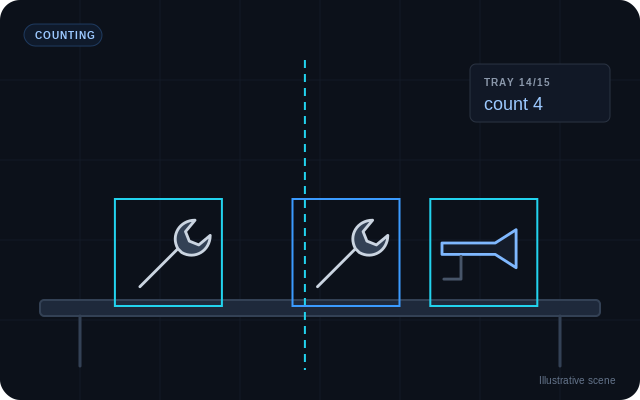
What can be checked
- Instruments on the tray
- Missing or extra instruments
- Instruments placed in wrong positions
What the team receives
- Completeness result per tray
- Image record for traceability
What the solution does
Fewer incomplete trays
Catches missing instruments before sterilization.
Faster assembly checks
Checks the instruments on a tray against the tray list from an image, reducing manual counting time in sterile processing.
Traceable records
Stores an image of each assembled tray, which supports traceability and the investigation of incomplete trays.
The operational problem
Incomplete instrument trays delay procedures and require reprocessing, and manual counting of many similar instruments is error-prone.
How visual intelligence helps
A camera images each assembled tray, instruments are identified and compared with the tray list, and technicians resolve any differences before wrapping.
Example visual workflow
- The technician places the assembled tray under the camera.
- Instruments are detected and identified.
- The result is compared with the tray list.
- The technician resolves differences and the record is stored.
Illustrative workflow — the actual pipeline is designed for each site during the PoC.
Edge deployment considerations
Processing runs on a workstation in the sterile processing department, keeping images inside the hospital network.
How the solution is built
AI capabilities
The AI tasks this use case combines.
- Counting and Measurement
Counting and measurement convert detections, tracks and masks into quantities — how many objects, how long they stayed, how big they are, how full an area is.
- Object Detection
Object detection finds and labels the objects in an image or video frame and marks each one with a bounding box.
Visual inputs
Cameras and imaging that typically supply the video.
- Industrial and Machine Vision Cameras
Industrial and machine vision cameras capture sharp, consistent images at fixed positions with controlled lighting and triggering.
- IP and Network Cameras
IP cameras stream digital video over standard networks and are the most common source for Edge AI video analytics.
Deployment options
General approaches to evaluate, not tested hardware. Specific hardware is selected and validated for each project during the PoC.
- Camera and VMS Integration
Most projects start with cameras that are already installed.
- Edge AI Hardware Sizing
Sizing Edge AI hardware means matching compute, memory, power and enclosure to the real workload — the number of streams, resolution, frame rate, models and latency targets — under the site's environmental and installation constraints.
- Edge Deployment Architectures
Edge-first means processing video at or near where it is captured.
- Industrial and Ruggedized Edge AI Computers
Industrial Edge AI computers and ruggedized systems house AI-capable processors in enclosures built for factories, vehicles and outdoor sites — wide temperature ranges, vibration, dust and industrial power.
Practical factors to plan for
Real-world results depend as much on the environment and camera setup as on the model.
Site and setup
- Similar instruments. Many instruments look alike; classes must follow the tray list precisely.
- Reflections. Stainless steel reflects light; diffuse lighting is needed.
Human review
Sterile processing technicians confirm results before trays are wrapped. No clinical decisions are made.
Limitations & scope
- Overlapping instruments are harder to identify.
- Instrument cleanliness and function are not verified.
Proof of Concept
Have a visual AI challenge? Let's prove it.
Share a video of what happens in your environment and describe the outcome you need. We review every request for technical feasibility, then agree the scope of a focused Proof of Concept (PoC) with you.
Example request: “We want to check our orthopedic trays against their instrument lists before wrapping.”
Every request is reviewed for technical feasibility. PoC scope, timing and terms are agreed individually.
Related topics
How this page connects to industries, use cases, AI tasks, input sources and deployment options.