Fundamentals
Object Detection vs Object Tracking — What Is the Difference?
Object detection finds objects in a single image; object tracking follows them across video frames. Understanding the difference — and how they work together — helps when scoping video analytics for counting, safety or monitoring.
EdgeTech editorial team ·
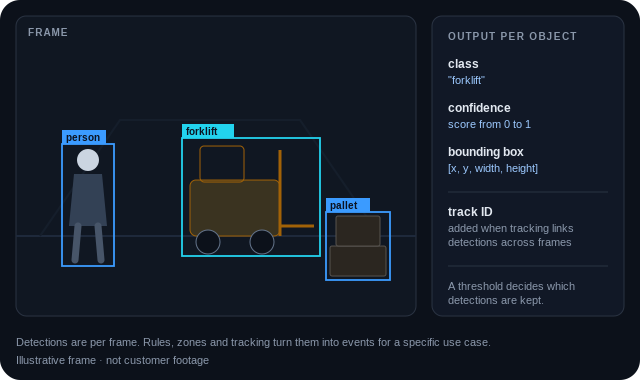
Detection: what and where, in one frame
Object detection looks at a single image and returns a list of objects: a class label (person, forklift, helmet), a confidence score and a bounding box. It has no memory. If the same forklift appears in the next frame, the detector simply reports it again.
Tracking: the same object over time
Object tracking links detections across frames and gives each object a persistent ID. With multi-object tracking, many objects are followed at once, and the system handles objects entering, leaving and temporarily disappearing.
Why the difference matters
Many business questions are about time, not single frames:
- Counting — detection alone would count the same person in every frame; tracking counts each person once as they cross a line.
- Dwell time — how long a vehicle waits at a gate requires following it.
- Alerts — one safety situation should produce one event, not hundreds.
Tracking is a processing mode, not a use case
Tracking is best understood as a capability built on detection. It supports many use cases — people counting, vehicle monitoring, asset tracking, queue measurement — without being a business application itself.
Practical considerations
- Frame rate. Tracking needs frames close enough in time; very low frame rates cause lost tracks.
- Occlusion. Crowds and equipment hide objects; elevated camera views help.
- Detection quality. A tracker cannot follow what the detector misses.
- Within one camera. Following people across multiple cameras is a separate, harder problem with privacy implications.
Choosing for your project
If you only need to know whether something is present, detection may be enough. If you need counts, durations, directions or de-duplicated events, plan for detection plus tracking from the start.