Use CaseTraffic and site vehicle statistics
Vehicle Counting and Classification
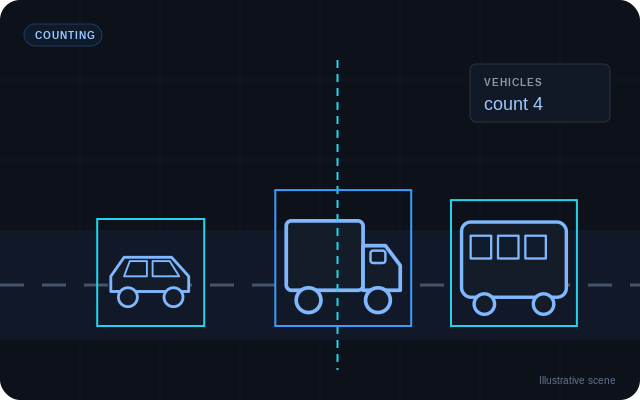
Count vehicles by class and direction at roads, gates, yards and car parks — cars, vans, trucks, buses, two-wheelers or site vehicles — producing traffic statistics and site activity data at the edge.
What can be checked
- Vehicles crossing counting lines, with direction
- Vehicle classes such as car, van, truck, bus, motorcycle or bicycle
- Site-specific classes such as forklifts, yard tractors or construction plant
What the team receives
- Counts per class, direction and time interval
- Peak and trend reports
- Threshold events, such as queues at a gate
What the solution does
Classifies as it counts
Splits traffic by vehicle type rather than producing a single total.
Direction and lane aware
Uses tracking across virtual lines to separate inbound, outbound and per-lane traffic.
Edge processing
Analyzes video at the roadside or gate so only counts need to be transmitted.
The problem
Traffic engineers, site managers and operators need to know how many vehicles of which types use a road, gate or yard, and when. Manual counts and loop detectors provide partial pictures and are expensive to expand.
How visual intelligence helps
Detection finds vehicles, classification assigns types, tracking follows each vehicle across a counting line. Counts are aggregated per interval and direction. Vehicle tracking is a processing mode inside this use case rather than a separate application.
Deployment considerations
Processing at the roadside or gate on Edge hardware keeps bandwidth low; results can feed traffic platforms or site systems.
How the solution is built
AI capabilities
The AI tasks this use case combines.
- Attribute Recognition
Attribute recognition determines properties of an object found by a detector — color, type, state, whether a helmet or vest is worn, whether a door is open.
- Counting and Measurement
Counting and measurement convert detections, tracks and masks into quantities — how many objects, how long they stayed, how big they are, how full an area is.
- Object Detection
Object detection finds and labels the objects in an image or video frame and marks each one with a bounding box.
- Object Tracking and Multi-Object Tracking
Object tracking links detections of the same object across consecutive video frames and assigns each one a persistent ID.
Visual inputs
Cameras and imaging that typically supply the video.
- CCTV and Existing Surveillance Systems
Many sites already run CCTV systems — analog cameras, DVRs, NVRs and video management systems.
- IP and Network Cameras
IP cameras stream digital video over standard networks and are the most common source for Edge AI video analytics.
Deployment options
General approaches to evaluate, not tested hardware. Specific hardware is selected and validated for each project during the PoC.
- Camera and VMS Integration
Most projects start with cameras that are already installed.
- Edge AI Hardware Sizing
Sizing Edge AI hardware means matching compute, memory, power and enclosure to the real workload — the number of streams, resolution, frame rate, models and latency targets — under the site's environmental and installation constraints.
- Edge Deployment Architectures
Edge-first means processing video at or near where it is captured.
Practical factors to plan for
Real-world results depend as much on the environment and camera setup as on the model.
Site and setup
- Class definitions. Standard road classes differ from site-specific vehicle types; classes are agreed upfront and may need custom training data.
- Viewpoint. Elevated views reduce occlusion between vehicles; side-on views help distinguish vehicle types.
- Night and weather. Headlight glare, rain and fog affect reliability; evaluation footage should include these conditions.
Human review
Counts are statistical estimates. Periodic manual validation counts are recommended, especially where data informs investment or billing decisions.
Limitations & scope
- Heavy congestion and occlusion reduce per-vehicle accuracy; counts are estimates.
- Fine-grained classes, such as axle counts or specific models, may not be distinguishable from every viewpoint.
- Number-plate reading is a separate capability with additional legal requirements and is not implied here.
Proof of Concept
Have a visual AI challenge? Let's prove it.
Share a video of what happens in your environment and describe the outcome you need. We review every request for technical feasibility, then agree the scope of a focused Proof of Concept (PoC) with you.
Example request: “We want to count trucks and cars entering our site gate by direction, per hour.”
Every request is reviewed for technical feasibility. PoC scope, timing and terms are agreed individually.
Frequently asked questions
Can existing traffic or gate cameras be used?
Often, if they view the traffic from a suitable height and angle. A sample of footage from each camera confirms feasibility.
Is vehicle tracking included?
Short-term tracking within the camera view is used to count reliably and determine direction. Longer journeys across cameras are a separate design question.
Related topics
How this page connects to industries, use cases, AI tasks, input sources and deployment options.