Use CaseAnonymous flow statistics
People Counting
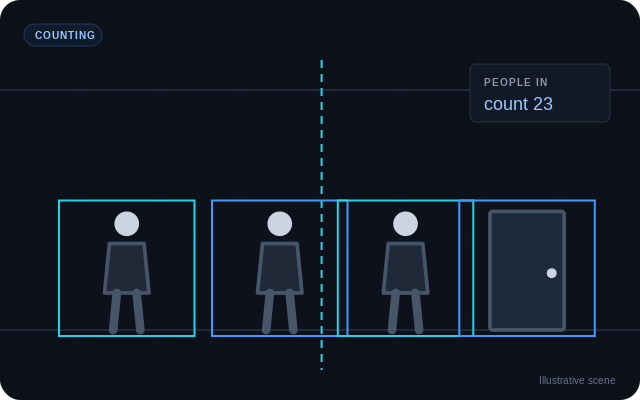
Count people entering, leaving or passing through defined lines and areas, producing anonymous statistics for staffing, space planning and safety — with video processed at the edge and no identification of individuals.
What can be checked
- People crossing a defined line or entering a defined area
- Direction of movement (in or out)
- Counts per time interval and per zone
What the team receives
- Counts per interval, direction and location
- Threshold alerts, such as an area exceeding a set number
- Trend reports for planning and staffing
What the solution does
Anonymous by design
Produces numbers, not identities. No face recognition or individual profiles are involved.
Direction-aware
Distinguishes entries from exits using tracking across a counting line.
Local processing
Analyzes video on site so only counts need to be sent to dashboards.
The problem
Organizations need to know how many people use their spaces and when — for staffing, cleaning, capacity limits and planning. Manual counts are occasional and expensive; door sensors miss direction and multiple people.
How visual intelligence helps
Object detection finds people in each frame, tracking follows them across a virtual line, and counting logic records direction and totals. Outputs are aggregate numbers suitable for dashboards and planning.
Deployment considerations
People counting suits Edge-only processing: video is analyzed and discarded on site, and only counts are sent onward. This keeps bandwidth low and privacy exposure minimal.
How the solution is built
AI capabilities
The AI tasks this use case combines.
- Counting and Measurement
Counting and measurement convert detections, tracks and masks into quantities — how many objects, how long they stayed, how big they are, how full an area is.
- Object Detection
Object detection finds and labels the objects in an image or video frame and marks each one with a bounding box.
- Object Tracking and Multi-Object Tracking
Object tracking links detections of the same object across consecutive video frames and assigns each one a persistent ID.
Visual inputs
Cameras and imaging that typically supply the video.
- CCTV and Existing Surveillance Systems
Many sites already run CCTV systems — analog cameras, DVRs, NVRs and video management systems.
- Depth, Stereo and 3D Cameras
Depth cameras measure distance to every point in view, using stereo vision, structured light or time-of-flight.
- IP and Network Cameras
IP cameras stream digital video over standard networks and are the most common source for Edge AI video analytics.
Deployment options
General approaches to evaluate, not tested hardware. Specific hardware is selected and validated for each project during the PoC.
- Camera and VMS Integration
Most projects start with cameras that are already installed.
- Edge AI Hardware Sizing
Sizing Edge AI hardware means matching compute, memory, power and enclosure to the real workload — the number of streams, resolution, frame rate, models and latency targets — under the site's environmental and installation constraints.
- Edge Deployment Architectures
Edge-first means processing video at or near where it is captured.
- Industrial and Ruggedized Edge AI Computers
Industrial Edge AI computers and ruggedized systems house AI-capable processors in enclosures built for factories, vehicles and outdoor sites — wide temperature ranges, vibration, dust and industrial power.
Practical factors to plan for
Real-world results depend as much on the environment and camera setup as on the model.
Site and setup
- Camera position. Overhead or steeply angled views reduce occlusion in crowds and improve counting accuracy compared with horizontal views.
- Crowd density. Very dense crowds are harder to count individually; area-based density estimation may be more appropriate.
- Privacy design. Counting does not require storing footage or identifying people; systems can discard frames after analysis.
Human review
Counts are statistical and should be spot-checked against manual counts during commissioning and periodically afterwards.
Limitations & scope
- Accuracy decreases with heavy occlusion, very dense crowds and unfavorable camera angles.
- Counts are estimates; for safety-critical capacity limits, use them alongside established procedures.
- Public-facing counting must comply with local privacy regulation and signage requirements.
Proof of Concept
Have a visual AI challenge? Let's prove it.
Share a video of what happens in your environment and describe the outcome you need. We review every request for technical feasibility, then agree the scope of a focused Proof of Concept (PoC) with you.
Example request: “We want hourly counts of people entering and leaving our main entrance, without storing video.”
Every request is reviewed for technical feasibility. PoC scope, timing and terms are agreed individually.
Frequently asked questions
Do you need to identify people to count them?
No. Counting uses detection and short-term tracking within the camera view. No identity is determined or stored.
What is the difference between people counting and occupancy monitoring?
People counting measures flows across lines; occupancy monitoring estimates how many people are inside an area at a time. They are often combined.
Related topics
How this page connects to industries, use cases, AI tasks, input sources and deployment options.