IndustryWeaving, knitting and finishing
Edge AI Video Intelligence for Textiles
Textile production inspects long runs of fabric for defects that vary widely in appearance. Edge AI video intelligence can support fabric defect detection, color and pattern checks and roll identification, with analysis at the line.
Common challenges
- Fabric defects such as holes, stains, slubs and weaving faults vary widely.
- Manual inspection of long fabric runs is tiring and inconsistent.
- Pattern and color deviations must be caught before cutting.
- Rolls must be traced to their inspection results.
Typical visual sources
- Line-scan cameras over inspection frames
- Industrial cameras at finishing and cutting stations
- Fixed cameras for roll handling and identification
Potential applications
Fabric defect detection
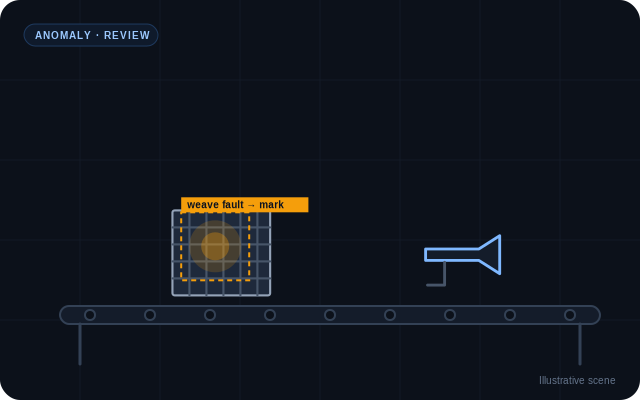
Flag holes, stains and weaving faults as fabric passes the inspection frame.
Pattern and color checks
Highlight deviations in print registration or shade before cutting.
Defect mapping
Record defect locations along the roll to support grading and cutting optimization.
Where video intelligence fits
Textile defects are visually diverse and fabric moves continuously, which makes consistent manual inspection difficult. Edge AI can scan the full width and length of a run and leave the decisions to experienced graders.
Typical Edge architecture
Line-scan imagery is processed by an Edge computer beside the inspection frame, producing a defect map per roll for grading and downstream systems.
Questions to answer early
- Which defect types matter most for grading?
- What fabric widths and speeds must be covered?
- How are rolls identified today?
Limitations & scope
- Defect visibility depends on lighting, fabric type and line speed.
- Shade assessment by camera requires calibrated, consistent lighting.
- Results are validated per fabric type and defect class.
Proof of Concept
Have a visual AI challenge? Let's prove it.
Share a video of what happens in your environment and describe the outcome you need. We review every request for technical feasibility, then agree the scope of a focused Proof of Concept (PoC) with you.
Example request: “We want to detect weaving faults on greige fabric at our inspection frame and mark their position on the roll.”
Every request is reviewed for technical feasibility. PoC scope, timing and terms are agreed individually.
Frequently asked questions
Can one model handle all our fabrics?
Usually models are evaluated per fabric family. Very different materials may need separate training data.
Can defects be mapped to roll positions?
Yes, by combining detections with line position data from the inspection frame.
Related topics
How this page connects to industries, use cases, AI tasks, input sources and deployment options.