Use CasePresence, position and print quality
Label Inspection
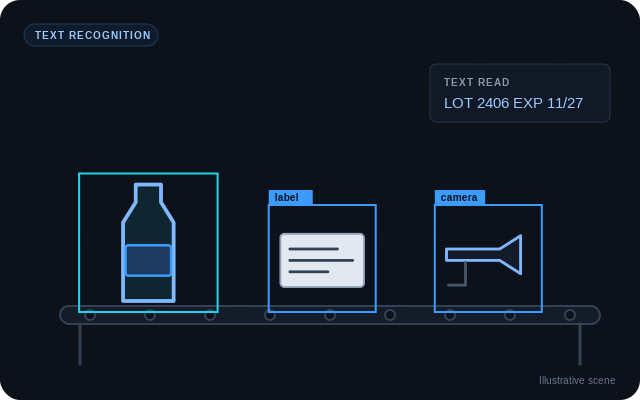
Verify that labels are present, correctly positioned and legible, and that printed text such as dates and lot codes is correct.
What can be checked
- Missing or skewed labels
- Smudged or incomplete print
- Wrong date or lot codes
What the team receives
- Pass or reject per unit
- Read text for traceability
What the solution does
Label presence
Detects missing, skewed, wrinkled and wrong labels on each pack, before products leave the line.
Code verification
Reads dates and lot codes and compares them with expected values.
Traceability
Stores read results and images per batch, which supports traceability and makes it easier to answer customer or recall queries.
The operational problem
Wrong, missing or illegible labels lead to recalls, rework and retailer penalties. At line speed, operators can only spot-check a small share of units.
How visual intelligence helps
Cameras check every label and read printed codes, rejecting units that do not match the expected data.
Example visual workflow
- Cameras capture the label on each unit.
- Presence and position are checked.
- OCR reads dates and codes.
- Mismatches trigger rejection and an alert.
Illustrative workflow — the actual pipeline is designed for each site during the PoC.
Edge deployment considerations
An Edge computer at the line performs presence checks and OCR within the cycle time and connects to the line controller and reject system. Expected values come from the production order rather than manual setup.
How the solution is built
AI capabilities
The AI tasks this use case combines.
- Defect Detection
Defect detection locates and classifies specific, known defect types — scratches, cracks, dents, contamination, missing features — in images of products or assets.
- OCR and Text Recognition
Optical character recognition (OCR) reads text visible in images — labels, codes, container numbers, displays and gauges.
Visual inputs
Cameras and imaging that typically supply the video.
- Industrial and Machine Vision Cameras
Industrial and machine vision cameras capture sharp, consistent images at fixed positions with controlled lighting and triggering.
Deployment options
General approaches to evaluate, not tested hardware. Specific hardware is selected and validated for each project during the PoC.
- Edge AI Hardware Sizing
Sizing Edge AI hardware means matching compute, memory, power and enclosure to the real workload — the number of streams, resolution, frame rate, models and latency targets — under the site's environmental and installation constraints.
- Edge Deployment Architectures
Edge-first means processing video at or near where it is captured.
- Industrial and Ruggedized Edge AI Computers
Industrial Edge AI computers and ruggedized systems house AI-capable processors in enclosures built for factories, vehicles and outdoor sites — wide temperature ranges, vibration, dust and industrial power.
Practical factors to plan for
Real-world results depend as much on the environment and camera setup as on the model.
Site and setup
- Print variability. Inkjet and laser codes vary in quality.
- Label variants. Each product needs its expected layout and text.
Human review
Rejected units are reviewed by operators. Code mismatches trigger a line check.
Limitations & scope
- Curved surfaces and glare reduce read rates.
- Validation is required for regulated products.
Proof of Concept
Have a visual AI challenge? Let's prove it.
Share a video of what happens in your environment and describe the outcome you need. We review every request for technical feasibility, then agree the scope of a focused Proof of Concept (PoC) with you.
Example request: “We want to verify the best-before date printed on bottle labels matches the production order.”
Every request is reviewed for technical feasibility. PoC scope, timing and terms are agreed individually.
Related topics
How this page connects to industries, use cases, AI tasks, input sources and deployment options.