Use CaseHoles, stains and weaving faults
Fabric Defect Detection
Detect holes, stains, broken yarns, slubs and weaving or knitting faults on moving fabric and map them along the roll for grading.
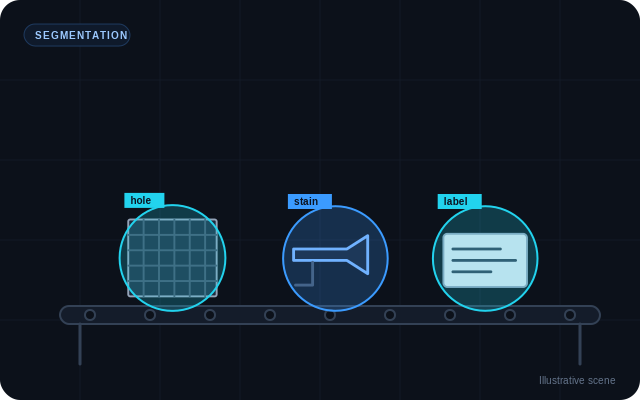
What can be checked
- Holes and tears
- Stains and oil spots
- Broken yarns slubs and weaving faults
What the team receives
- Defect map per roll
- Grade suggestion based on defect counts
What the solution does
Full coverage
Inspects the full width and length of the fabric as it runs, rather than relying on samples or occasional manual checks.
Roll maps
Supports grading and cutting optimization.
Consistent results
Applies the same defect classes and limits on every shift, reducing variation between individual inspectors.
The operational problem
Manual fabric inspection is tiring and inconsistent, and missed defects lead to waste when garments are cut.
How visual intelligence helps
Cameras scan the fabric continuously and AI models record each defect with its position, giving graders a complete roll map.
Example visual workflow
- Line-scan cameras capture the fabric width at the inspection frame.
- Models detect defects and classify them.
- Defects are mapped to roll position.
- Graders review the map and confirm the grade.
Illustrative workflow — the actual pipeline is designed for each site during the PoC.
Edge deployment considerations
An Edge computer beside the inspection frame processes images in real time and stores maps per roll.
How the solution is built
AI capabilities
The AI tasks this use case combines.
- Defect Detection
Defect detection locates and classifies specific, known defect types — scratches, cracks, dents, contamination, missing features — in images of products or assets.
- Semantic Segmentation
Semantic segmentation assigns a class to every pixel of an image — road, floor, water, smoke, crop, background — producing a map of regions rather than individual objects.
Visual inputs
Cameras and imaging that typically supply the video.
- High-Speed Cameras
High-speed cameras capture hundreds or thousands of frames per second, revealing events too fast for standard cameras — on fast packaging lines, in machinery or in process analysis.
- Industrial and Machine Vision Cameras
Industrial and machine vision cameras capture sharp, consistent images at fixed positions with controlled lighting and triggering.
Deployment options
General approaches to evaluate, not tested hardware. Specific hardware is selected and validated for each project during the PoC.
- Edge AI Hardware Sizing
Sizing Edge AI hardware means matching compute, memory, power and enclosure to the real workload — the number of streams, resolution, frame rate, models and latency targets — under the site's environmental and installation constraints.
- Edge Deployment Architectures
Edge-first means processing video at or near where it is captured.
- Industrial and Ruggedized Edge AI Computers
Industrial Edge AI computers and ruggedized systems house AI-capable processors in enclosures built for factories, vehicles and outdoor sites — wide temperature ranges, vibration, dust and industrial power.
Practical factors to plan for
Real-world results depend as much on the environment and camera setup as on the model.
Site and setup
- Fabric type. Patterned or textured fabrics need separate models.
- Illumination. Backlight and front light reveal different defect types.
Human review
Graders review the defect map and decide on roll grade and cutting plan.
Limitations & scope
- Low-contrast defects on dark fabric are harder to detect.
- Very fast lines need high-throughput hardware.
Proof of Concept
Have a visual AI challenge? Let's prove it.
Share a video of what happens in your environment and describe the outcome you need. We review every request for technical feasibility, then agree the scope of a focused Proof of Concept (PoC) with you.
Example request: “We want to detect holes and oil stains on knitted fabric at our inspection frame.”
Every request is reviewed for technical feasibility. PoC scope, timing and terms are agreed individually.
Related topics
How this page connects to industries, use cases, AI tasks, input sources and deployment options.