Use CaseFlow, stoppages and process deviations
Production Line and Process Monitoring
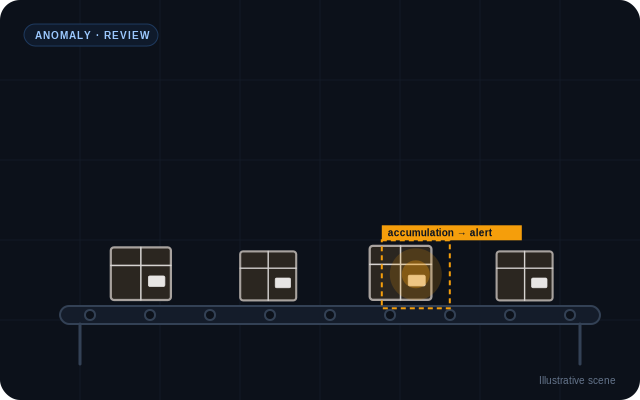
Monitor production and packing lines with cameras to detect jams, stoppages, accumulation, missing steps and unusual process behavior — giving operators earlier visibility, with analysis at the line.
What can be checked
- Jams, blockages and accumulation on conveyors
- Stoppages and idle periods at stations
- Missing or out-of-sequence process steps where visible
- Unusual material flow or process appearance
What the team receives
- Real-time alerts to operators and supervisors
- Downtime and micro-stoppage statistics
- Event logs with images for root-cause analysis
What the solution does
Earlier visibility
Spots jams and stoppages as they develop, before they cascade along the line.
Explains downtime
Adds visual evidence to downtime records for faster root-cause analysis.
Detects process anomalies
Highlights visual behavior that differs from normal operation, even when it was not predefined.
The problem
Small stoppages and jams add up to significant lost production, and many are not captured accurately in downtime records. Operators cannot watch every section of a line continuously.
How visual intelligence helps
Detection and tracking measure flow and accumulation; activity recognition and anomaly detection highlight unusual behavior. Events with images explain what happened, when.
Deployment considerations
Line monitoring runs at the edge for timely alerts. Aggregated statistics can be combined across lines or plants with Cloud services where useful.
How the solution is built
AI capabilities
The AI tasks this use case combines.
- Action and Activity Recognition
Action recognition identifies short actions — picking, lifting, opening a door — while activity recognition describes longer sequences such as a loading operation or a procedure.
- Object Detection
Object detection finds and labels the objects in an image or video frame and marks each one with a bounding box.
- Object Tracking and Multi-Object Tracking
Object tracking links detections of the same object across consecutive video frames and assigns each one a persistent ID.
- Scene Understanding
Scene understanding interprets an image as a whole — what kind of place it is, which objects are present, how they relate and what state the area is in.
- Visual Anomaly Detection
Visual anomaly detection learns what normal looks like and flags images, regions or events that deviate from it.
Visual inputs
Cameras and imaging that typically supply the video.
- High-Speed Cameras
High-speed cameras capture hundreds or thousands of frames per second, revealing events too fast for standard cameras — on fast packaging lines, in machinery or in process analysis.
- Industrial and Machine Vision Cameras
Industrial and machine vision cameras capture sharp, consistent images at fixed positions with controlled lighting and triggering.
- IP and Network Cameras
IP cameras stream digital video over standard networks and are the most common source for Edge AI video analytics.
Deployment options
General approaches to evaluate, not tested hardware. Specific hardware is selected and validated for each project during the PoC.
- Camera and VMS Integration
Most projects start with cameras that are already installed.
- Edge AI Hardware Sizing
Sizing Edge AI hardware means matching compute, memory, power and enclosure to the real workload — the number of streams, resolution, frame rate, models and latency targets — under the site's environmental and installation constraints.
- Edge Deployment Architectures
Edge-first means processing video at or near where it is captured.
- Industrial and Ruggedized Edge AI Computers
Industrial Edge AI computers and ruggedized systems house AI-capable processors in enclosures built for factories, vehicles and outdoor sites — wide temperature ranges, vibration, dust and industrial power.
Practical factors to plan for
Real-world results depend as much on the environment and camera setup as on the model.
Site and setup
- Defining normal. Normal flow varies by product and shift; baseline footage of normal operation is needed to detect deviations.
- Integration with line data. Combining video events with machine data from PLCs or MES gives better context for root-cause analysis.
- Alert design. Operators need few, relevant alerts. Thresholds are tuned to avoid alert fatigue.
Human review
Alerts inform operators; decisions to stop, adjust or restart equipment remain with trained staff and established controls.
Limitations & scope
- Only visible symptoms can be detected; issues inside machines need other sensors.
- Anomaly detection can flag harmless variation; tuning and operator feedback are part of commissioning.
- Video monitoring supplements machine controls and safety systems and does not control equipment itself.
Proof of Concept
Have a visual AI challenge? Let's prove it.
Share a video of what happens in your environment and describe the outcome you need. We review every request for technical feasibility, then agree the scope of a focused Proof of Concept (PoC) with you.
Example request: “We want an alert when cartons start backing up on the conveyor before the case sealer.”
Every request is reviewed for technical feasibility. PoC scope, timing and terms are agreed individually.
Frequently asked questions
How is this different from quality inspection?
Quality inspection examines each product. Line monitoring examines the process — flow, timing and behavior — around the products.
Can it detect problems it has not been trained on?
Anomaly-detection approaches learn normal behavior and flag deviations, which can include unforeseen issues. They require tuning to keep false alerts manageable.
Related topics
How this page connects to industries, use cases, AI tasks, input sources and deployment options.