Use CaseProcedures, signage and housekeeping
Visual Compliance Monitoring
Check that visible procedures and conditions are followed — housekeeping, signage, barriers, step sequences or hygiene routines — and surface deviations as reviewable events, with processing at the edge.
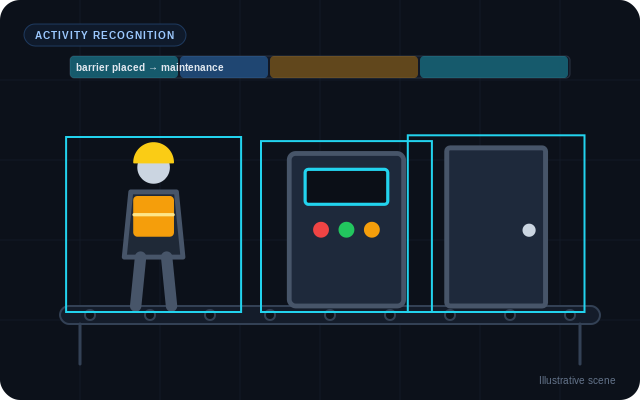
What can be checked
- Barriers, cones or signage missing from where they should be
- Blocked walkways, exits or equipment access
- Steps of a visible procedure performed out of order or skipped
- Hygiene routines such as handwashing station use, where visible
What the team receives
- Deviation events with time and snapshot
- Compliance rates by area, shift or procedure
- Evidence for audits and continuous improvement
What the solution does
Consistent checks
Applies the same visible criteria across shifts and locations.
Evidence for improvement
Provides data on where and when procedures are hard to follow, guiding process changes.
Configurable rules
Rules are defined per area and procedure rather than one-size-fits-all.
The problem
Procedures and housekeeping standards exist on paper but are checked only during audits or walks. Deviations between checks go unnoticed, and audit evidence is limited.
How visual intelligence helps
Object detection checks presence and position of barriers, signs or equipment; activity recognition checks sequences; scene understanding considers the overall state of an area. Rules translate procedures into observable criteria.
Deployment considerations
Edge processing on site keeps footage local. Aggregated compliance rates can be reported centrally for multi-site organizations.
How the solution is built
AI capabilities
The AI tasks this use case combines.
- Action and Activity Recognition
Action recognition identifies short actions — picking, lifting, opening a door — while activity recognition describes longer sequences such as a loading operation or a procedure.
- Object Detection
Object detection finds and labels the objects in an image or video frame and marks each one with a bounding box.
- Pose Estimation
Pose estimation locates keypoints — such as shoulders, elbows, knees or the corners of an object — and connects them into a skeleton or structure.
- Scene Understanding
Scene understanding interprets an image as a whole — what kind of place it is, which objects are present, how they relate and what state the area is in.
Visual inputs
Cameras and imaging that typically supply the video.
- Body-Worn and Wearable Cameras
Body-worn and head-mounted cameras capture what field workers see — for remote assistance, inspection documentation and procedure verification.
- CCTV and Existing Surveillance Systems
Many sites already run CCTV systems — analog cameras, DVRs, NVRs and video management systems.
- IP and Network Cameras
IP cameras stream digital video over standard networks and are the most common source for Edge AI video analytics.
Deployment options
General approaches to evaluate, not tested hardware. Specific hardware is selected and validated for each project during the PoC.
- Camera and VMS Integration
Most projects start with cameras that are already installed.
- Edge AI Hardware Sizing
Sizing Edge AI hardware means matching compute, memory, power and enclosure to the real workload — the number of streams, resolution, frame rate, models and latency targets — under the site's environmental and installation constraints.
- Edge Deployment Architectures
Edge-first means processing video at or near where it is captured.
- Standalone Edge AI Devices
Standalone Edge AI devices are compact, self-contained units — AI boxes or smart cameras — that process video locally at a single location.
Practical factors to plan for
Real-world results depend as much on the environment and camera setup as on the model.
Site and setup
- Observable criteria. Only criteria that are clearly visible on camera can be checked; procedures are translated into observable rules with the process owner.
- Procedure variation. Legitimate variations in how work is done must be distinguished from real deviations.
- Workforce acceptance. Transparent communication about purpose and data use is important for acceptance.
Human review
Deviations are reviewed by supervisors or quality staff. The system highlights possible issues; it does not judge individuals.
Limitations & scope
- Compliance that is not visible on camera cannot be checked.
- Video compliance supports audits and supervision; it does not certify compliance with any standard.
- Workplace monitoring requires attention to employment law, works councils where applicable and privacy rules.
Proof of Concept
Have a visual AI challenge? Let's prove it.
Share a video of what happens in your environment and describe the outcome you need. We review every request for technical feasibility, then agree the scope of a focused Proof of Concept (PoC) with you.
Example request: “We want to check that the safety barrier is placed before maintenance starts on the packaging machine.”
Every request is reviewed for technical feasibility. PoC scope, timing and terms are agreed individually.
Frequently asked questions
Is PPE compliance part of visual compliance?
PPE compliance is a specific, common case and has its own page. Visual compliance covers broader procedures and conditions.
Can step sequences be checked?
Where steps are visually distinct, activity recognition can check order and presence. Feasibility depends on how distinguishable the steps are on camera.
Related topics
How this page connects to industries, use cases, AI tasks, input sources and deployment options.