AI TaskCrossings, dwell, speed and paths
Zone and Line Analytics
Zone and line analytics apply rules to tracked objects — counting line crossings, measuring time spent in a zone, estimating speed and comparing paths with expected routes. They turn tracks into operational events such as entries, dwell times, queue lengths and wrong-way movement.
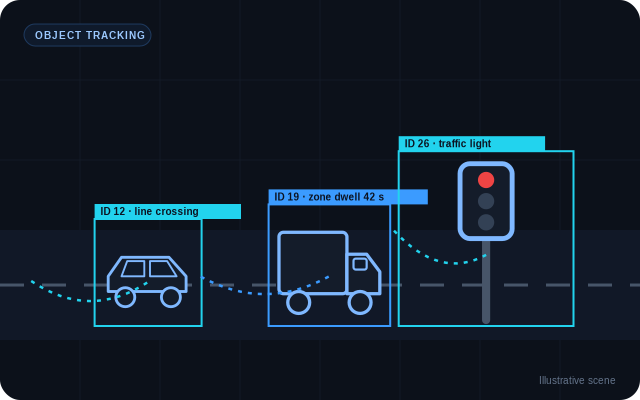
Definition
Zone and line analytics sit on top of detection and tracking. Virtual lines count directional crossings; polygon zones measure occupancy and time in zone; calibrated geometry converts motion into speed; and path rules compare trajectories with expected routes.
Typical outputs
- Directional line-crossing counts
- Dwell time and occupancy per zone
- Speed estimates and path-deviation events
Where it is used
Counting and flow
People, vehicles and goods crossing entrances, gates and conveyor points.
Dwell and waiting
Queue times, loitering and vehicles waiting at docks or curbs.
Movement rules
Wrong-way movement, speed estimates and route deviations.
How it works
Objects are detected and tracked; each track is then evaluated against configured lines and zones. Crossings, entries, exits, dwell times, speeds and path deviations become timestamped events.
Designing the rules
Good results start with clear definitions — which direction counts as an entry, how long counts as dwelling, which path is expected — and with validation against manual observation.
Edge considerations
Rule evaluation is light and runs beside tracking on the Edge device. Only events and aggregates are sent to dashboards, which keeps bandwidth and personal data exposure low.
Running it at the edge
Model, resolution, frame rate and hardware are planned together for each project.
Design considerations
- Tracking quality. Reliable crossings and dwell times depend on stable tracks through occlusion.
- Calibration for speed. Speed in real units needs camera calibration and known distances in the scene.
- Events, not video. Rules run on the Edge device and emit small events instead of streaming video.
Limitations & scope
- Results inherit tracking errors; crowded scenes lead to missed or duplicated crossings.
- Speed estimates are approximate unless the setup is calibrated and validated; they are not enforcement evidence.
- Zones and lines must be redrawn if a camera is moved.
Proof of Concept
Have a visual AI challenge? Let's prove it.
Share a video of what happens in your environment and describe the outcome you need. We review every request for technical feasibility, then agree the scope of a focused Proof of Concept (PoC) with you.
Example request: “We want dwell times of trucks in each loading zone and alerts when a vehicle waits more than 20 minutes.”
Every request is reviewed for technical feasibility. PoC scope, timing and terms are agreed individually.
Frequently asked questions
How is this different from counting and measurement?
Counting and measurement is the broader task. Zone and line analytics are the rule layer that defines what is counted and when, based on tracks.
Can zones be changed without retraining?
Yes. Zones and lines are configuration, not part of the model.
Related topics
How this page connects to industries, use cases, AI tasks, input sources and deployment options.