Input SourcePan, tilt and zoom coverage
PTZ Cameras
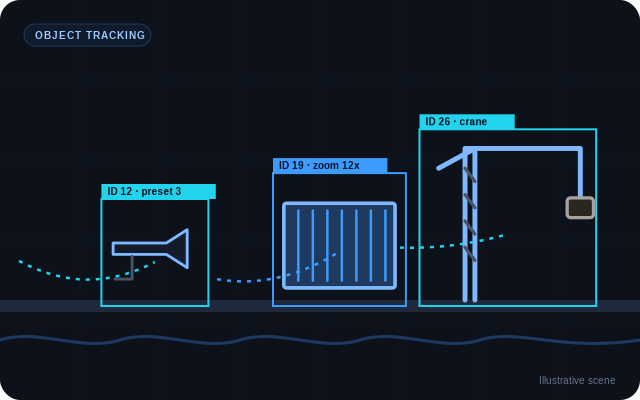
Pan-tilt-zoom cameras can turn and zoom to cover large areas from one position. For Edge AI video analytics they offer wide coverage and close-up detail on demand — but moving views require analytics that understand presets, zoom levels and changing scenes.
Where processing can run
- Edge server beside the camera network. Streams are analyzed on site, and detections can steer the camera to zoom in on an object of interest.
- Preset-aware analytics. Different zones and rules are applied for each preset position the camera visits.
What this source enables
Wide-area coverage
One camera patrols a port, yard, perimeter or site through several preset views.
Detail on demand
Zooming in on a detected vehicle, vessel or object for verification or reading text.
Detection-driven tracking
Edge analytics can steer the camera to follow a moving object across the scene.
Coverage with movement
PTZ cameras combine wide coverage with the ability to zoom in on details. That flexibility changes how analytics are designed: rules are tied to presets, and models must handle many different scales.
Pairing fixed and PTZ cameras
A common design pairs a fixed wide-angle camera, which watches continuously, with a PTZ camera that is pointed by Edge analytics to capture detail when something of interest appears.
Integration
PTZ control and stream access are verified per manufacturer and model. EdgeTech does not assume compatibility with a specific product before testing it.
What to consider
Practical factors that determine which architecture and models are feasible.
Platform and mission
- Presets versus free movement. Analytics with zones and lines work best on fixed presets; free movement requires scene-independent models or re-calibration.
- Zoom changes scale. Object sizes change dramatically with zoom, which affects detection thresholds and measurement.
- Control interfaces. Automatic pointing uses standard control protocols such as ONVIF PTZ; compatibility is verified per camera model.
Limitations & scope
- While a PTZ camera looks at one area, it does not see the others; gaps in coverage are inherent.
- Auto-tracking of one object can miss other events in the scene.
- Mechanical PTZ units need maintenance, and control compatibility varies between manufacturers.
Proof of Concept
Have a visual AI challenge? Let's prove it.
Share a video of what happens in your environment and describe the outcome you need. We review every request for technical feasibility, then agree the scope of a focused Proof of Concept (PoC) with you.
Example request: “We want our port PTZ cameras to zoom in automatically on vessels entering the basin and record their approach.”
Every request is reviewed for technical feasibility. PoC scope, timing and terms are agreed individually.
Frequently asked questions
Can analytics run on a moving PTZ camera?
Yes, with care. Detection works on any view, but zone-based rules need preset positions or scene re-calibration after movement.
Can Edge AI control where the camera points?
Where the camera supports a standard control interface, detections can trigger presets or follow objects. This is verified per camera model during a PoC.
Related topics
How this page connects to industries, use cases, AI tasks, input sources and deployment options.