Use CaseCorrect sequence and placement
Assembly Step Verification
Confirm that assembly steps are completed in the right order and that parts are placed correctly, supporting operators at manual workstations.
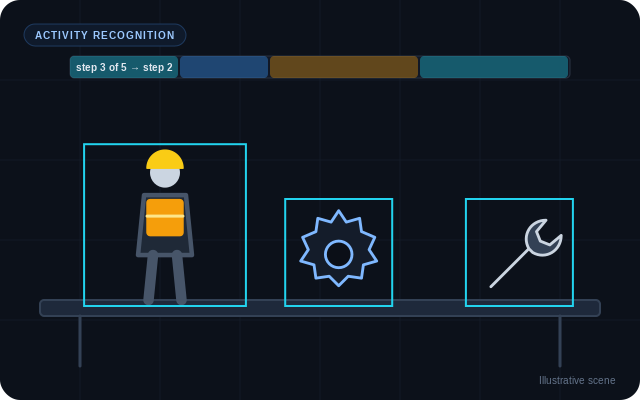
What can be checked
- Parts picked from the correct bins
- Parts placed in the correct positions
- Steps completed in the expected order
What the team receives
- Step confirmation for the operator
- Assembly record per unit
What the solution does
Operator guidance
Confirms each step as the operator works.
Fewer errors
Detects skipped, out-of-order or incorrect steps at the station, before the unit moves on and the error becomes costly to fix.
Training support
Gives new operators step-by-step confirmation while they learn a sequence, reducing the supervision needed during ramp-up.
The operational problem
Manual assembly with many variants depends on operators following the correct sequence. Mistakes are often discovered only at final test.
How visual intelligence helps
Video analytics recognizes steps and placements and gives the operator immediate confirmation, catching mistakes when they are easy to fix.
Example visual workflow
- An overhead camera observes the workstation.
- Hand movements and part placements are recognized per step.
- The operator sees confirmation or a hint on a display.
- Each unit’s assembly record is stored.
Illustrative workflow — the actual pipeline is designed for each site during the PoC.
Edge deployment considerations
Processing runs at the workstation so feedback is instant and video stays on site; only step results are stored.
How the solution is built
AI capabilities
The AI tasks this use case combines.
- Action and Activity Recognition
Action recognition identifies short actions — picking, lifting, opening a door — while activity recognition describes longer sequences such as a loading operation or a procedure.
- Object Detection
Object detection finds and labels the objects in an image or video frame and marks each one with a bounding box.
Visual inputs
Cameras and imaging that typically supply the video.
- Depth, Stereo and 3D Cameras
Depth cameras measure distance to every point in view, using stereo vision, structured light or time-of-flight.
- IP and Network Cameras
IP cameras stream digital video over standard networks and are the most common source for Edge AI video analytics.
Deployment options
General approaches to evaluate, not tested hardware. Specific hardware is selected and validated for each project during the PoC.
- Camera and VMS Integration
Most projects start with cameras that are already installed.
- Edge AI Hardware Sizing
Sizing Edge AI hardware means matching compute, memory, power and enclosure to the real workload — the number of streams, resolution, frame rate, models and latency targets — under the site's environmental and installation constraints.
- Edge Deployment Architectures
Edge-first means processing video at or near where it is captured.
- Industrial and Ruggedized Edge AI Computers
Industrial Edge AI computers and ruggedized systems house AI-capable processors in enclosures built for factories, vehicles and outdoor sites — wide temperature ranges, vibration, dust and industrial power.
Practical factors to plan for
Real-world results depend as much on the environment and camera setup as on the model.
Site and setup
- Workstation layout. Clear bin positions and an overhead view make steps easier to recognize.
- Operator acceptance. Workers should be involved in defining feedback and alerts.
Human review
The operator receives feedback and decides how to correct a step. Supervisors review recurring issues, not individuals.
Limitations & scope
- Fast or occluded hand movements may be missed.
- Workplace video use must be agreed with employees and comply with labor rules.
Proof of Concept
Have a visual AI challenge? Let's prove it.
Share a video of what happens in your environment and describe the outcome you need. We review every request for technical feasibility, then agree the scope of a focused Proof of Concept (PoC) with you.
Example request: “We want to confirm that operators insert the gasket before the cover at our pump assembly station.”
Every request is reviewed for technical feasibility. PoC scope, timing and terms are agreed individually.
Related topics
How this page connects to industries, use cases, AI tasks, input sources and deployment options.