IndustryVehicle and component production
Edge AI Video Intelligence for Automotive
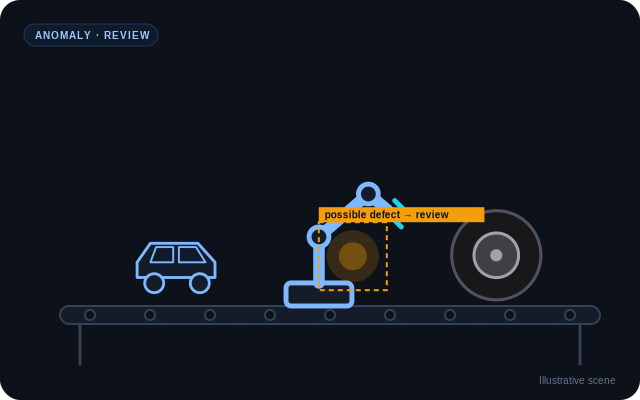
Automotive production combines high-volume assembly, strict quality requirements and complex logistics. Edge AI video intelligence can support visual inspection, assembly verification, safety around automation and part flow — with processing on the line.
Common challenges
- Visual checks for presence, position and surface quality must keep pace with takt time.
- Assembly errors such as missing or incorrectly placed parts are costly if caught late.
- People work close to robots, conveyors and automated guided vehicles.
- Inbound parts and kits must be verified before they reach the line.
Typical visual sources
- Industrial and machine vision cameras at inspection and assembly stations
- High-speed cameras for fast-moving processes
- Fixed IP cameras covering robot cells, aisles and logistics areas
Potential applications
Assembly verification
Check that components are present, oriented correctly and in the right position before the vehicle or part moves on.
Surface and defect inspection
Flag possible scratches, dents, gaps or paint issues for confirmation by quality staff.
Robot-cell and AGV safety
Detect people entering protected zones around robots or automated vehicles as an additional awareness layer.
Kitting and part verification
Verify kit contents and part labels against what the next station expects.
Video intelligence on the line
Automotive production already uses machine vision for many checks. Edge AI extends what can be inspected — variable defects, complex assemblies and situations that rule-based vision struggles with — while keeping processing close to the line so decisions keep pace with production.
Beyond inspection
The same Edge infrastructure can support safety awareness around robots and automated vehicles, monitoring of part flow between logistics and assembly, and verification of kits and labels. Starting with one station and one well-defined check keeps risk low and results measurable.
Questions to answer early
- Which defect or assembly error is most costly today, and how is it caught?
- Is controlled lighting possible at the inspection point?
- What happens with a flagged part: stop the line, divert it, or alert an inspector?
Limitations & scope
- Inline inspection usually needs controlled lighting and fixed camera geometry; general-purpose CCTV is rarely sufficient.
- Video-based safety awareness supplements, and never replaces, certified safety systems such as light curtains and interlocks.
- Defect detection is validated against agreed defect classes and samples from your process.
Proof of Concept
Have a visual AI challenge? Let's prove it.
Share a video of what happens in your environment and describe the outcome you need. We review every request for technical feasibility, then agree the scope of a focused Proof of Concept (PoC) with you.
Example request: “We want to confirm that every clip on a door panel is fitted before the panel leaves the station.”
Every request is reviewed for technical feasibility. PoC scope, timing and terms are agreed individually.
Frequently asked questions
Can existing line cameras be reused?
Sometimes. Machine vision cameras already installed for other checks may provide suitable images. A short assessment of resolution, lighting and timing confirms whether they can be reused.
How fast does inline inspection need to be?
It depends on takt time and the number of checks per part. The model, image resolution and Edge hardware are sized together to meet the required cycle time.
Related topics
How this page connects to industries, use cases, AI tasks, input sources and deployment options.
Use Cases
- Assembly Step Verification
- Casting Defect Detection
- Composite Defect Inspection
- Dimensional Measurement from Images
- Fastener and Rivet Inspection
- Manual Workstation Cycle Time Analysis
- Missing Component Detection
- Product Detection and Verification
- Production Line and Process Monitoring
- Quality Inspection and Defect Detection
- Restricted Area Monitoring
- Robotic Visual Inspection
- Serial Number and Part Marking Reading
- Steel and Metal Surface Inspection
- Surface Scratch and Cosmetic Defect Detection
- Vehicle Damage Inspection
- VIN Reading
- Weld Seam Inspection
- Wire Harness and Connector Inspection
- Workplace Safety Monitoring