Use CaseVehicle composition at checkpoints
Axle and Wagon Counting
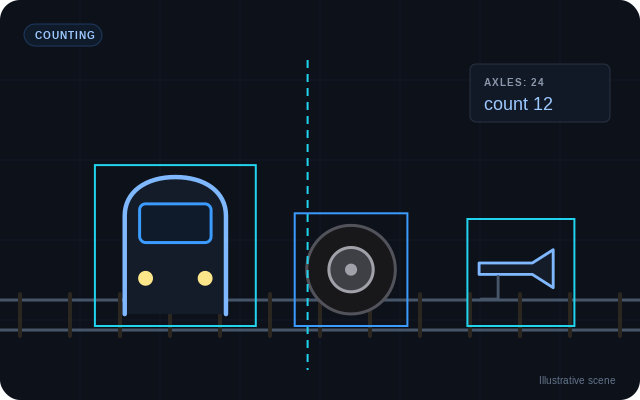
Count axles, wagons or trailers and classify vehicles at checkpoints such as yard entries, weighbridges and toll points to support logistics and maintenance records.
What can be checked
- Axles on passing vehicles
- Wagons or trailers in a train or combination
- Vehicle class
What the team receives
- Counts per vehicle or train
- Composition records with timestamps
What the solution does
Automatic records
Replaces manual tallying of axles and wagons with automatic records per passage.
Composition checks
Flags mismatches with the expected consist.
Maintenance input
Produces per-wagon axle passage counts that maintenance teams can feed into wheelset usage and inspection schedules.
The operational problem
Vehicle and train compositions are often recorded manually at yards and terminals, causing errors and delays.
How visual intelligence helps
A side-view camera counts axles and units automatically and compares them with expected compositions.
Example visual workflow
- A side camera captures passing vehicles.
- Wheels and units are detected and counted.
- Composition is compared with expected data.
- Exceptions are flagged.
Illustrative workflow — the actual pipeline is designed for each site during the PoC.
Edge deployment considerations
A trackside or gate Edge device processes video locally and sends composition records to yard or terminal systems. It runs independently of signaling equipment and does not interface with safety systems.
How the solution is built
AI capabilities
The AI tasks this use case combines.
- Counting and Measurement
Counting and measurement convert detections, tracks and masks into quantities — how many objects, how long they stayed, how big they are, how full an area is.
- Object Detection
Object detection finds and labels the objects in an image or video frame and marks each one with a bounding box.
Visual inputs
Cameras and imaging that typically supply the video.
- High-Speed Cameras
High-speed cameras capture hundreds or thousands of frames per second, revealing events too fast for standard cameras — on fast packaging lines, in machinery or in process analysis.
- IP and Network Cameras
IP cameras stream digital video over standard networks and are the most common source for Edge AI video analytics.
Deployment options
General approaches to evaluate, not tested hardware. Specific hardware is selected and validated for each project during the PoC.
- Camera and VMS Integration
Most projects start with cameras that are already installed.
- Edge AI Hardware Sizing
Sizing Edge AI hardware means matching compute, memory, power and enclosure to the real workload — the number of streams, resolution, frame rate, models and latency targets — under the site's environmental and installation constraints.
- Edge Deployment Architectures
Edge-first means processing video at or near where it is captured.
- Industrial and Ruggedized Edge AI Computers
Industrial Edge AI computers and ruggedized systems house AI-capable processors in enclosures built for factories, vehicles and outdoor sites — wide temperature ranges, vibration, dust and industrial power.
Practical factors to plan for
Real-world results depend as much on the environment and camera setup as on the model.
Site and setup
- Side view. A clear side view at a known distance is needed.
- Speed range. Very fast passages need high frame rates.
Human review
Operators review exceptions such as mismatched compositions. Signaling-grade axle counters remain separate systems.
Limitations & scope
- Not a replacement for safety-certified axle counters used in signaling.
- Occlusion by adjacent traffic affects counts.
Proof of Concept
Have a visual AI challenge? Let's prove it.
Share a video of what happens in your environment and describe the outcome you need. We review every request for technical feasibility, then agree the scope of a focused Proof of Concept (PoC) with you.
Example request: “We want to count wagons and axles of trains entering our terminal and compare with the manifest.”
Every request is reviewed for technical feasibility. PoC scope, timing and terms are agreed individually.
Related topics
How this page connects to industries, use cases, AI tasks, input sources and deployment options.