IndustryTransport, yards and cross-docks
Edge AI Video Intelligence for Logistics
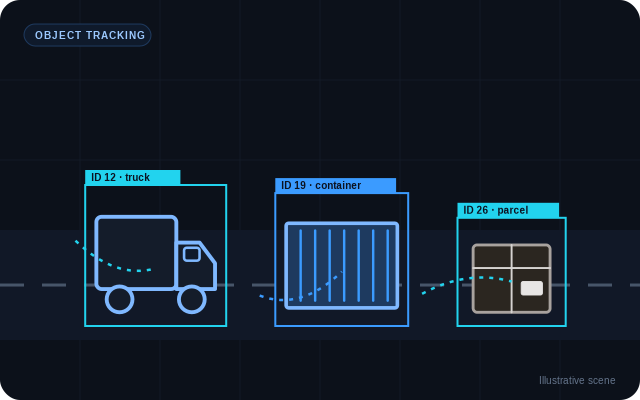
Logistics operations depend on vehicles, trailers, containers and parcels moving on time through yards, hubs and cross-docks. Edge AI video intelligence can make that flow visible — reading identifiers, counting movements and flagging bottlenecks where they occur.
Common challenges
- Gate, yard and dock activity is recorded manually or not at all, creating gaps in visibility.
- Trailer, container and vehicle identifiers must be captured accurately at entry and exit points.
- Congestion at gates and docks is noticed late, after it has already caused delays.
- Hubs operate around the clock with limited supervisory staff per shift.
Typical visual sources
- Fixed IP cameras at gates, weighbridges, yards and dock doors
- Vehicle-mounted cameras on trucks and yard tractors
- Overhead cameras on sortation lines and parcel conveyors
Potential applications
Gate and yard visibility
Count and classify vehicles entering and leaving, and record queue lengths at gates and weighbridges.
Identifier reading
Read container codes, trailer numbers or labels with OCR where the text is visible and legible on camera.
Dock utilization
Detect trailer presence, door status and loading activity to support dock scheduling.
Parcel flow monitoring
Spot jams, overflows and unusual stoppages on conveyors and sorters.
Making flow visible
Logistics performance is about flow: how long a truck waits at the gate, how quickly a dock turns around, where parcels back up. Video already covers many of these points. Edge AI video intelligence converts it into structured events — entries, exits, dwell times, counts and identifiers — at the location where decisions are made.
Edge-first in distributed networks
Logistics networks are spread across many sites with varying connectivity. Processing video at each site keeps alerts local and sends only events and metadata to a central system. This reduces bandwidth and keeps the architecture workable at remote depots.
Questions to answer early
- Which handover points matter most: gates, docks, sorters or yards?
- Which identifiers must be captured, and how visible are they on existing cameras?
- Where should the results go: a dashboard, a yard system or a transport management system?
Limitations & scope
- OCR accuracy depends on text size, angle, dirt, damage and lighting; some identifiers will need manual confirmation.
- Number-plate reading has legal and privacy implications that must be reviewed for each jurisdiction.
- Outdoor yards add weather, glare and night conditions that must be evaluated on real footage.
Proof of Concept
Have a visual AI challenge? Let's prove it.
Share a video of what happens in your environment and describe the outcome you need. We review every request for technical feasibility, then agree the scope of a focused Proof of Concept (PoC) with you.
Example request: “We need to log which trailers enter and leave our yard, and how long each waits at the gate.”
Every request is reviewed for technical feasibility. PoC scope, timing and terms are agreed individually.
Frequently asked questions
Can container or trailer codes be read automatically?
Often, when the code is visible, large enough in the image and reasonably clean. A proof of concept on footage from your actual gates is the reliable way to find out.
Does this replace our yard management system?
No. Video analytics provides events and counts that can feed or complement existing yard and transport management systems.
Related topics
How this page connects to industries, use cases, AI tasks, input sources and deployment options.
Use Cases
- AMR Obstacle Perception
- Asset Tracking and Monitoring
- Axle and Wagon Counting
- Baggage Handling Monitoring
- Container Damage Inspection
- Container ID Recognition
- Depalletizing Guidance
- Dock Door Monitoring
- Driver Fatigue and Distraction Monitoring
- Drone-Based Inventory Scanning
- Forklift and Pedestrian Proximity Awareness
- Inventory Monitoring
- License Plate Recognition
- Loading and Unloading Monitoring
- Order Packing Verification
- Package Damage Detection
- Pallet Counting and Identification
- Parcel Detection and Counting
- Parking Monitoring
- Product Detection and Verification
- Queue Monitoring
- Rack Damage Detection
- Rebar and Pipe Counting
- Shipping Label Reading
- Slab and Coil ID Reading
- Tire and Wheel Inspection
- Traffic Monitoring
- Vehicle Counting and Classification
- Vehicle Damage Inspection
- VIN Reading
- Yard and Trailer Tracking