Use CaseObjective timing of manual work steps
Manual Workstation Cycle Time Analysis
Measure cycle times and waiting times at manual workstations from video, giving industrial engineers objective data for line balancing without stopwatch studies.
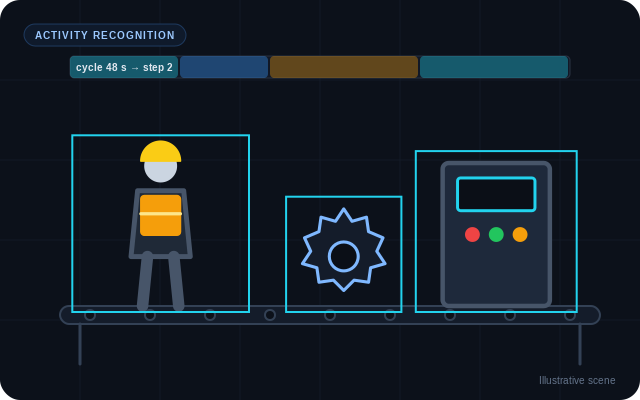
What can be checked
- Start and end of work cycles
- Waiting and idle periods at a station
- Material arrival at the station
What the team receives
- Cycle time distributions per station
- Bottleneck indicators
What the solution does
Objective data
Replaces short stopwatch samples with continuous measurement.
Bottleneck visibility
Shows which stations limit line output and how much their cycle times vary, so improvement work starts where it matters most.
Station focus
Reports by station rather than by person.
The operational problem
Line balancing relies on occasional stopwatch studies that capture only a few cycles and change behavior while the observer is present.
How visual intelligence helps
Activity recognition marks the start and end of cycles and waiting periods at each station. Engineers get continuous distributions and see where the line is constrained.
Example visual workflow
- Cameras view the workstations.
- Cycle start and end events are recognized.
- Cycle and waiting times are aggregated per station.
- Engineers use the data for line balancing.
Illustrative workflow — the actual pipeline is designed for each site during the PoC.
Edge deployment considerations
Video is processed on an Edge computer on the shop floor and discarded after analysis; only station-level timing data is stored.
How the solution is built
AI capabilities
The AI tasks this use case combines.
- Action and Activity Recognition
Action recognition identifies short actions — picking, lifting, opening a door — while activity recognition describes longer sequences such as a loading operation or a procedure.
- Object Detection
Object detection finds and labels the objects in an image or video frame and marks each one with a bounding box.
Visual inputs
Cameras and imaging that typically supply the video.
- IP and Network Cameras
IP cameras stream digital video over standard networks and are the most common source for Edge AI video analytics.
Deployment options
General approaches to evaluate, not tested hardware. Specific hardware is selected and validated for each project during the PoC.
- Camera and VMS Integration
Most projects start with cameras that are already installed.
- Edge AI Hardware Sizing
Sizing Edge AI hardware means matching compute, memory, power and enclosure to the real workload — the number of streams, resolution, frame rate, models and latency targets — under the site's environmental and installation constraints.
- Edge Deployment Architectures
Edge-first means processing video at or near where it is captured.
Practical factors to plan for
Real-world results depend as much on the environment and camera setup as on the model.
Site and setup
- Station definition. Each station needs a clear visual start and end event.
- Works council. Workplace video use must be agreed with employee representatives.
Human review
Industrial engineers interpret station-level statistics. Data is aggregated per station and is not used to rate individual workers.
Limitations & scope
- Complex tasks with unclear start and end events are hard to time.
- Employee consultation and transparency are required.
Proof of Concept
Have a visual AI challenge? Let's prove it.
Share a video of what happens in your environment and describe the outcome you need. We review every request for technical feasibility, then agree the scope of a focused Proof of Concept (PoC) with you.
Example request: “We want cycle-time distributions for the six manual stations on our final assembly line.”
Every request is reviewed for technical feasibility. PoC scope, timing and terms are agreed individually.
Related topics
How this page connects to industries, use cases, AI tasks, input sources and deployment options.