Use CaseFlame presence and smoke indicators
Flare Monitoring
Observe flare stacks with visual and thermal cameras to record flame presence, visible smoke and flaring events for operations and reporting support.
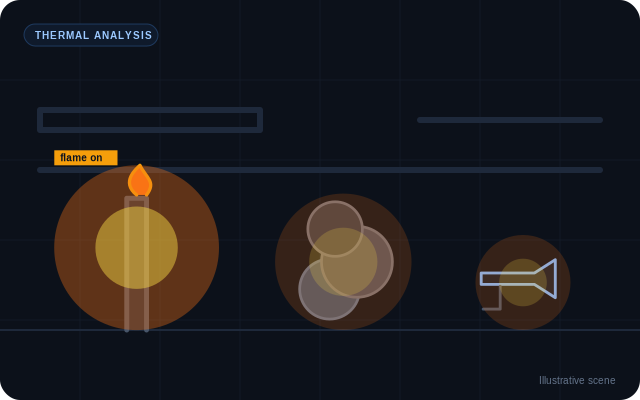
What can be checked
- Flame presence and size
- Visible smoke
- Flaring events
What the team receives
- Event timelines
- Alerts on smoke
What the solution does
Continuous observation
Records every flaring event with start, end and images.
Smoke alerts
Highlights visible smoke so operators can respond quickly.
Reporting support
Provides event logs that support internal and regulatory reporting.
The operational problem
Flaring events and visible smoke must be observed continuously, but manual observation is impractical, especially at night.
How visual intelligence helps
Visual and thermal cameras record flame presence and visible smoke. Events are logged and smoke triggers alerts for operators.
Example visual workflow
- Cameras view the flare.
- Flame and smoke are analyzed.
- Events are logged.
- Operators review alerts.
Illustrative workflow — the actual pipeline is designed for each site during the PoC.
Edge deployment considerations
Processing runs on site close to the cameras, and only flaring events, smoke alerts and snapshots are sent to the control room.
How the solution is built
AI capabilities
The AI tasks this use case combines.
- Image and Object Classification
Classification assigns a label to a whole image or to an individual object crop — good or defective, running or stopped, product variant A or B.
- Visual Anomaly Detection
Visual anomaly detection learns what normal looks like and flags images, regions or events that deviate from it.
Visual inputs
Cameras and imaging that typically supply the video.
- IP and Network Cameras
IP cameras stream digital video over standard networks and are the most common source for Edge AI video analytics.
- Thermal and Infrared Cameras
Thermal cameras image heat (long-wave infrared), while near-infrared cameras use invisible illumination to see in darkness.
Deployment options
General approaches to evaluate, not tested hardware. Specific hardware is selected and validated for each project during the PoC.
- Camera and VMS Integration
Most projects start with cameras that are already installed.
- Edge AI Hardware Sizing
Sizing Edge AI hardware means matching compute, memory, power and enclosure to the real workload — the number of streams, resolution, frame rate, models and latency targets — under the site's environmental and installation constraints.
- Edge Deployment Architectures
Edge-first means processing video at or near where it is captured.
- Industrial and Ruggedized Edge AI Computers
Industrial Edge AI computers and ruggedized systems house AI-capable processors in enclosures built for factories, vehicles and outdoor sites — wide temperature ranges, vibration, dust and industrial power.
Practical factors to plan for
Real-world results depend as much on the environment and camera setup as on the model.
Site and setup
- Weather. Fog and rain reduce visibility.
- Thermal views. Thermal cameras work at night.
Human review
Operators verify events. Analytics support but do not replace regulatory emissions measurement.
Limitations & scope
- Not a certified emissions measurement.
- Weather affects detection.
Proof of Concept
Have a visual AI challenge? Let's prove it.
Share a video of what happens in your environment and describe the outcome you need. We review every request for technical feasibility, then agree the scope of a focused Proof of Concept (PoC) with you.
Example request: “We want a log of visible smoke events at our refinery flare.”
Every request is reviewed for technical feasibility. PoC scope, timing and terms are agreed individually.
Related topics
How this page connects to industries, use cases, AI tasks, input sources and deployment options.