IndustryUpstream, midstream and downstream
Edge AI Video Intelligence for Oil and Gas
Oil and gas facilities operate in hazardous, often remote environments where safety, integrity and security are critical. Edge AI video intelligence can support safety compliance, leak and spill awareness, asset inspection and perimeter monitoring — processed on site.
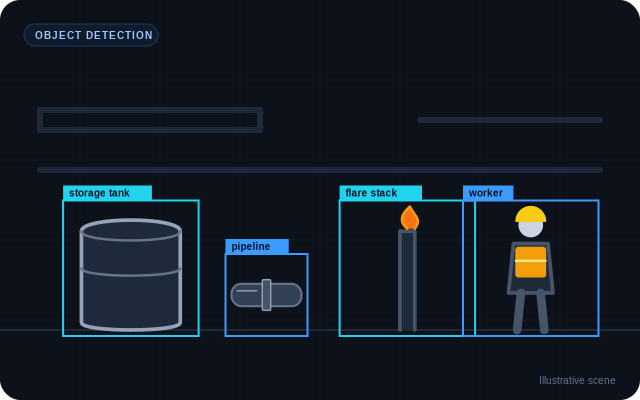
Common challenges
- Personnel work in hazardous areas where PPE and permit rules are strict.
- Visible leaks, spills, smoke or flare anomalies must be noticed quickly.
- Pipelines, wellpads and terminals cover large areas with limited staff.
- Remote locations have constrained connectivity and harsh environmental conditions.
Typical visual sources
- Fixed and PTZ cameras on process areas, wellpads and terminals
- Thermal and infrared cameras for heat-related anomalies
- Drones and inspection robots for pipelines, tanks and hard-to-reach equipment
Potential applications
PPE and permit-area compliance
Check required PPE and detect entry into restricted or permit-controlled areas for supervisor review.
Spill and smoke awareness
Flag visible spills, pooling liquid or smoke as an additional layer alongside certified detection systems.
Asset and pipeline inspection
Analyze drone or robot footage to highlight possible corrosion, damage or encroachment for engineers.
Remote site security
Detect people or vehicles at fences and unmanned facilities outside expected times.
Safety and integrity first
In oil and gas, the most valuable visual use cases protect people and assets: confirming PPE in hazardous areas, noticing visible spills or smoke sooner, and extending inspection coverage of pipelines and equipment. Each is framed as decision support for qualified staff.
Edge-first in harsh environments
Facilities are often remote and connectivity is limited or tightly controlled. Processing on site keeps sensitive footage within the facility and sends only events onward. Hardware must be rated for temperature, dust and, where applicable, hazardous-area classification.
Questions to answer early
- Which hazards or integrity risks matter most at this facility?
- What area classification applies where equipment would be installed?
- Which existing systems should receive alerts and findings?
Limitations & scope
- Hazardous-area installations require equipment certified for the zone; hardware selection must respect site classification.
- Video-based spill, smoke or gas awareness never replaces certified gas, fire and leak detection systems.
- Footage from hazardous sites may be confidential; data-handling terms are agreed before any is shared.
Proof of Concept
Have a visual AI challenge? Let's prove it.
Share a video of what happens in your environment and describe the outcome you need. We review every request for technical feasibility, then agree the scope of a focused Proof of Concept (PoC) with you.
Example request: “We want to know if visible liquid pooling appears around our pump skids, using existing process-area cameras.”
Every request is reviewed for technical feasibility. PoC scope, timing and terms are agreed individually.
Frequently asked questions
Can video analytics detect gas leaks?
Standard cameras cannot see most gases. Specialized optical gas imaging cameras exist, but this site does not claim gas detection capability; visible effects such as spills or vapor clouds can be evaluated case by case.
Can processing run at unmanned wellpads?
Edge processing on site, with suitable power and a certified enclosure where required, allows local analysis and sends only events over limited links.
Related topics
How this page connects to industries, use cases, AI tasks, input sources and deployment options.
Use Cases
- Corrosion Detection
- Equipment Monitoring
- Fire and Smoke Detection
- Flare Monitoring
- Gas Leak Indicators with Optical Imaging
- Industrial Visual Inspection
- Man-Down and Worker Fall Detection
- Meter and Gauge Reading
- Oil Sheen and Spill Detection on Water
- Perimeter Monitoring and Intrusion Detection
- Pipeline Right-of-Way Monitoring
- PPE Compliance Monitoring
- Spill Detection