Use CasePeople and vehicles near haul trucks and loaders
Heavy Vehicle Proximity Awareness
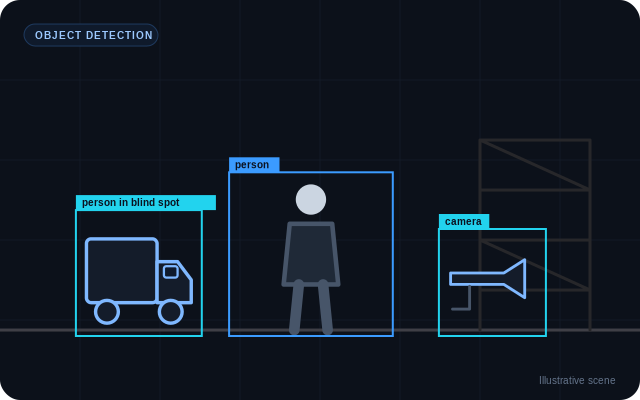
Detect people and light vehicles near haul trucks, loaders and excavators as an additional awareness layer for operators on mine and construction sites.
What can be checked
- People near the vehicle
- Light vehicles in blind spots
- Proximity distance estimates
What the team receives
- In-cab alerts
- Event logs
What the solution does
Blind spot awareness
Shows people in areas the operator cannot see.
Operator support
Provides immediate in-cab alerts when people are close to the machine.
Event data
Logs proximity events that support safety analysis and training.
The operational problem
Heavy vehicles have large blind spots, and people or light vehicles in those areas face serious risks.
How visual intelligence helps
Cameras around the vehicle detect people and light vehicles nearby and show alerts in the cab. Events are logged for safety analysis.
Example visual workflow
- Cameras around the vehicle capture surroundings.
- People and vehicles are detected.
- Alerts are shown in the cab.
- Events are logged.
Illustrative workflow — the actual pipeline is designed for each site during the PoC.
Edge deployment considerations
Onboard Edge modules run detection with low latency and keep working without network coverage.
How the solution is built
AI capabilities
The AI tasks this use case combines.
- Object Detection
Object detection finds and labels the objects in an image or video frame and marks each one with a bounding box.
Visual inputs
Cameras and imaging that typically supply the video.
- Thermal and Infrared Cameras
Thermal cameras image heat (long-wave infrared), while near-infrared cameras use invisible illumination to see in darkness.
- Vehicle-Mounted Cameras
Cameras on trucks, rail vehicles, forklifts, buses and service vehicles capture visual data while moving — for road and rail inspection, operational safety and fleet operations.
Deployment options
General approaches to evaluate, not tested hardware. Specific hardware is selected and validated for each project during the PoC.
- Edge AI Hardware Sizing
Sizing Edge AI hardware means matching compute, memory, power and enclosure to the real workload — the number of streams, resolution, frame rate, models and latency targets — under the site's environmental and installation constraints.
- Edge Deployment Architectures
Edge-first means processing video at or near where it is captured.
- Industrial and Ruggedized Edge AI Computers
Industrial Edge AI computers and ruggedized systems house AI-capable processors in enclosures built for factories, vehicles and outdoor sites — wide temperature ranges, vibration, dust and industrial power.
- NVIDIA Jetson Platforms
NVIDIA Jetson modules combine CPU, GPU and AI acceleration in compact, power-efficient form factors, and are widely used for embedded Edge AI.
- Standalone Edge AI Devices
Standalone Edge AI devices are compact, self-contained units — AI boxes or smart cameras — that process video locally at a single location.
Practical factors to plan for
Real-world results depend as much on the environment and camera setup as on the model.
Site and setup
- Environment. Dust, vibration and weather affect cameras.
- Latency. Alerts must be immediate.
Human review
Operators decide on actions. The system is not a certified collision avoidance system.
Limitations & scope
- Not a certified collision avoidance system.
- Dust and night reduce performance.
Proof of Concept
Have a visual AI challenge? Let's prove it.
Share a video of what happens in your environment and describe the outcome you need. We review every request for technical feasibility, then agree the scope of a focused Proof of Concept (PoC) with you.
Example request: “We want in-cab alerts when people are detected behind our wheel loaders.”
Every request is reviewed for technical feasibility. PoC scope, timing and terms are agreed individually.
Related topics
How this page connects to industries, use cases, AI tasks, input sources and deployment options.