IndustryPits, plants and haulage
Edge AI Video Intelligence for Mining
Mines operate heavy equipment in dusty, remote and constantly changing environments with limited connectivity. Edge AI video intelligence can support safety around haul roads and plant, conveyor monitoring and material visibility — processed on site.
Common challenges
- Large haul trucks and mobile plant operate near people and light vehicles.
- Conveyors and crushers run continuously, and blockages or spillage are costly.
- Dust, vibration, extreme temperatures and night operations degrade imaging conditions.
- Remote locations have constrained networks and power.
Typical visual sources
- Ruggedized fixed cameras at conveyors, crushers, loading points and workshops
- Vehicle-mounted cameras on haul trucks and mobile plant
- Drones for stockpile, pit and tailings imagery
Potential applications
People near heavy equipment
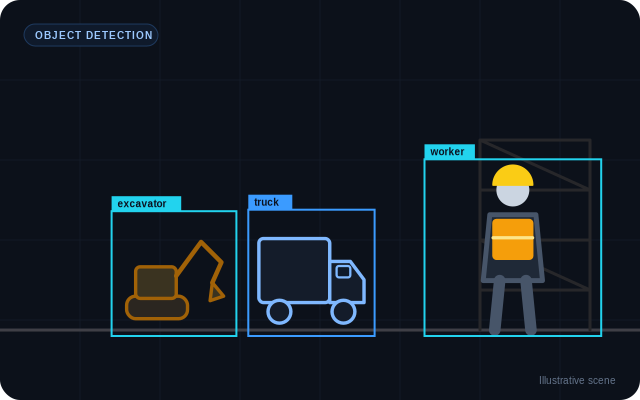
Detect people in exclusion zones around mobile plant and loading points as an additional awareness layer.
Conveyor monitoring
Flag belt blockages, spillage, misalignment or unusual material flow for operators.
Material and stockpile visibility
Estimate activity at loading points and capture stockpile changes from fixed or aerial views.
PPE in plant areas
Check required protective equipment in processing plants and workshops.
Harsh conditions, high stakes
Mining combines some of the most demanding imaging conditions with some of the highest safety stakes. Video intelligence projects here focus on specific, well-bounded problems — a conveyor transfer point, a loading bay, a workshop entrance — where cameras can be maintained and results acted on.
Why Edge processing matters
Mines are often far from reliable networks. Processing on ruggedized Edge hardware on site keeps alerts working regardless of connectivity, and avoids streaming continuous video from remote locations.
Questions to answer early
- Which risk or production loss is most important to address first?
- What camera housing, power and maintenance access are possible at that location?
- Which control room or system should receive the results?
Limitations & scope
- Dust, water spray and vibration affect image quality; camera housings and cleaning routines are part of the design.
- Collision-avoidance and proximity systems in mining are safety-certified; video awareness supplements them and is not a replacement.
- Volume measurements from imagery require calibration and validation against survey data.
Proof of Concept
Have a visual AI challenge? Let's prove it.
Share a video of what happens in your environment and describe the outcome you need. We review every request for technical feasibility, then agree the scope of a focused Proof of Concept (PoC) with you.
Example request: “We want to detect material spillage under a conveyor transfer point and alert the control room.”
Every request is reviewed for technical feasibility. PoC scope, timing and terms are agreed individually.
Frequently asked questions
Can vision work in dusty mining environments?
It can, with appropriate housings, positioning and maintenance, but performance degrades in heavy dust. Evaluation footage should include the worst typical conditions.
Can drones measure stockpiles?
Drone photogrammetry is an established survey method. Video analytics can complement it, but measurement accuracy must be validated against survey results.
Related topics
How this page connects to industries, use cases, AI tasks, input sources and deployment options.
Use Cases
- Conveyor Belt Monitoring
- Driver Fatigue and Distraction Monitoring
- Equipment Monitoring
- Heavy Equipment Utilization Tracking
- Heavy Vehicle Proximity Awareness
- Ore and Rock Type Classification
- PPE Compliance Monitoring
- Production Line and Process Monitoring
- Rock Fragmentation Analysis
- Spill Detection
- Stockpile Volume Estimation
- Thermal Equipment Monitoring
- Workplace Safety Monitoring