IndustrySites, progress and safety
Edge AI Video Intelligence for Construction
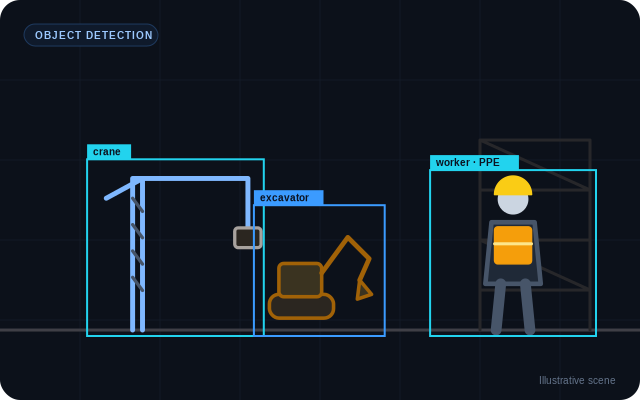
Construction sites change daily, span large areas and often lack reliable connectivity. Edge AI video intelligence can support safety compliance, site security and progress visibility using fixed, mobile and aerial cameras — processed on site.
Common challenges
- PPE and exclusion-zone rules must be followed by changing crews and subcontractors.
- Heavy plant and people work in close proximity on uneven, changing ground.
- Sites are often unattended at night and vulnerable to theft and intrusion.
- Progress and material deliveries are hard to verify across large areas.
Typical visual sources
- Temporary or mast-mounted IP cameras with local power and connectivity
- Drones for progress capture and inspection of structures
- Cameras mounted on plant and site vehicles
Potential applications
PPE and safety compliance
Check hard hats and high-visibility clothing in defined zones and flag possible issues for site supervisors.
Exclusion zones around plant
Detect people entering the working radius of excavators, cranes or other heavy equipment.
Perimeter and after-hours monitoring
Detect people or vehicles entering a closed site outside working hours.
Progress and delivery visibility
Count deliveries and capture visual progress over time from fixed or aerial viewpoints.
A changing environment
Unlike a factory, a construction site is never finished. Camera positions move, zones change and crews rotate. Video intelligence for construction therefore needs to be easy to reconfigure and robust to changing conditions, and its scope should be defined around a few high-risk activities.
Edge-first by necessity
Many sites have limited connectivity and power. Processing video on site — on a compact Edge AI device or a ruggedized computer — keeps alerts working when the network is weak and avoids streaming continuous video over cellular links.
Questions to answer early
- Which activities carry the highest risk on this site?
- What power, mounting and connectivity are available, and for how long?
- Who receives alerts, and how quickly can they act?
Limitations & scope
- Sites change constantly; camera positions and zone definitions need maintenance as work progresses.
- Remote sites may have limited power and bandwidth, which shapes the Edge hardware and reporting options.
- Video awareness supports the site safety plan and does not replace supervision or certified safety systems.
Proof of Concept
Have a visual AI challenge? Let's prove it.
Share a video of what happens in your environment and describe the outcome you need. We review every request for technical feasibility, then agree the scope of a focused Proof of Concept (PoC) with you.
Example request: “We want an alert when someone walks inside the swing radius of an excavator on our site.”
Every request is reviewed for technical feasibility. PoC scope, timing and terms are agreed individually.
Frequently asked questions
Can this work on a site without fixed internet?
Yes. Edge processing can run locally with alerts delivered over a cellular link or the site network. Hardware and power options are chosen for the site conditions.
Can drone footage be used for progress tracking?
Drone footage can support visual progress capture and inspection. Whether specific measurements are feasible depends on the footage, flight pattern and accuracy needed.
Related topics
How this page connects to industries, use cases, AI tasks, input sources and deployment options.
Use Cases
- Aerial Mapping and Feature Extraction
- Construction Progress Monitoring
- Crack Detection on Concrete and Structures
- Crane Lift Zone Monitoring
- Heavy Equipment Utilization Tracking
- Heavy Vehicle Proximity Awareness
- Industrial Visual Inspection
- Perimeter Monitoring and Intrusion Detection
- PPE Compliance Monitoring
- Rebar and Pipe Counting
- Restricted Area Monitoring
- Stockpile Volume Estimation
- Visual Compliance Monitoring
- Wood and Lumber Defect Grading
- Working at Height Safety Awareness
- Workplace Safety Monitoring