Use CaseCrushed, torn or open parcels
Package Damage Detection
Flag crushed, torn, wet or open packages on conveyors and at receiving and shipping points to catch damage before shipment and document it on arrival.
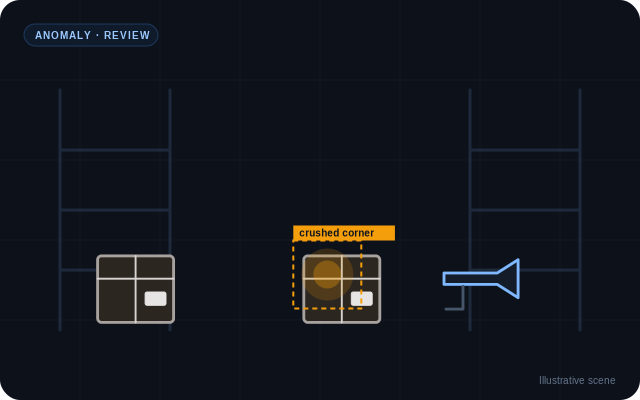
What can be checked
- Crushed or deformed packages
- Torn or open packaging
- Wet or stained packages
What the team receives
- Damage flag with image
- Damage statistics per lane or carrier
What the solution does
Earlier detection
Detects crushed, torn and wet packages at key points in the flow, before they are loaded and shipped to customers.
Claims evidence
Records each package's condition with a time-stamped image at handover, which supports damage claims and disputes.
Process insight
Shows where in the flow packages are being damaged.
The operational problem
Damaged packages lead to claims and customer complaints, and it is often unclear where damage happened.
How visual intelligence helps
Cameras at receiving, sortation or outbound points check the visible condition of every package. Damaged packages are flagged or diverted, and images are stored to show where in the flow damage occurred.
Example visual workflow
- Cameras capture packages on a conveyor.
- Models check visible package condition.
- Damaged packages are diverted or flagged.
- Images are stored for claims.
Illustrative workflow — the actual pipeline is designed for each site during the PoC.
Edge deployment considerations
Edge devices beside conveyors analyze images in real time and can trigger diverters. Images and events stay within the site network unless needed for carrier claims.
How the solution is built
AI capabilities
The AI tasks this use case combines.
- Defect Detection
Defect detection locates and classifies specific, known defect types — scratches, cracks, dents, contamination, missing features — in images of products or assets.
- Visual Anomaly Detection
Visual anomaly detection learns what normal looks like and flags images, regions or events that deviate from it.
Visual inputs
Cameras and imaging that typically supply the video.
- Industrial and Machine Vision Cameras
Industrial and machine vision cameras capture sharp, consistent images at fixed positions with controlled lighting and triggering.
- IP and Network Cameras
IP cameras stream digital video over standard networks and are the most common source for Edge AI video analytics.
Deployment options
General approaches to evaluate, not tested hardware. Specific hardware is selected and validated for each project during the PoC.
- Camera and VMS Integration
Most projects start with cameras that are already installed.
- Edge AI Hardware Sizing
Sizing Edge AI hardware means matching compute, memory, power and enclosure to the real workload — the number of streams, resolution, frame rate, models and latency targets — under the site's environmental and installation constraints.
- Edge Deployment Architectures
Edge-first means processing video at or near where it is captured.
- Industrial and Ruggedized Edge AI Computers
Industrial Edge AI computers and ruggedized systems house AI-capable processors in enclosures built for factories, vehicles and outdoor sites — wide temperature ranges, vibration, dust and industrial power.
Practical factors to plan for
Real-world results depend as much on the environment and camera setup as on the model.
Site and setup
- Conveyor speed. Fast conveyors need short exposure times.
- Views. Several cameras may be needed to see all sides.
Human review
Staff review flagged packages and decide on repacking or claims.
Limitations & scope
- Damage inside intact packaging is not visible.
- Bottom surfaces may need an extra camera.
Proof of Concept
Have a visual AI challenge? Let's prove it.
Share a video of what happens in your environment and describe the outcome you need. We review every request for technical feasibility, then agree the scope of a focused Proof of Concept (PoC) with you.
Example request: “We want to flag crushed or open cartons on our outbound conveyor before loading.”
Every request is reviewed for technical feasibility. PoC scope, timing and terms are agreed individually.
Related topics
How this page connects to industries, use cases, AI tasks, input sources and deployment options.