IndustryStorage and fulfillment
Edge AI Video Intelligence for Warehousing
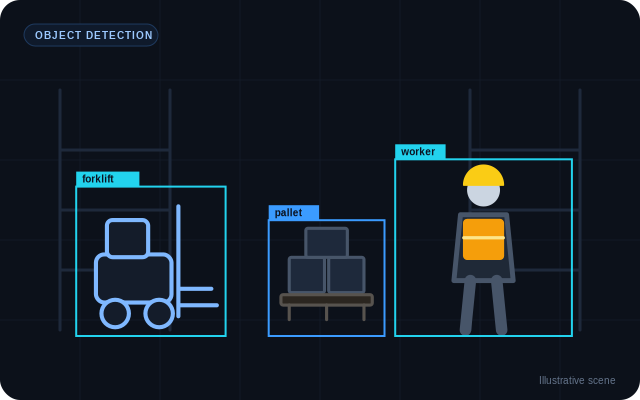
Warehouses combine fast-moving people, forklifts, racking and inventory in tight spaces. Edge AI video intelligence can help teams see safety risks, stock movements and dock activity as they happen — processed on site, close to the cameras.
Common challenges
- Pedestrians and forklifts share aisles and docks, and near-misses often go unrecorded.
- Stock locations, pallet counts and empty slots drift from what the warehouse system expects.
- Dock and yard congestion is hard to see in real time across many doors and shifts.
- Large buildings and mezzanines make continuous manual supervision impractical.
Typical visual sources
- Fixed IP and existing CCTV cameras over aisles, docks and pick areas
- Cameras mounted on forklifts or autonomous mobile robots
- Overhead cameras at conveyors, sorters and packing stations
Potential applications
Forklift and pedestrian safety
Detect people in forklift zones or near reversing vehicles and flag close interactions for safety review.
Dock and loading visibility
Monitor door occupancy, loading progress and trailer presence to support yard and dock planning.
Inventory and slot visibility
Estimate empty or occupied pallet positions and spot misplaced stock from fixed or mobile cameras.
Asset and pallet movement
Track the movement of pallets, carts and equipment through defined zones and handover points.
Where video intelligence fits in a warehouse
Warehouses already record large amounts of video, mostly for incident review. The opportunity is to turn the same footage into timely signals: a person in a forklift lane, a dock door blocked for longer than planned, a pick face that is empty. These are narrow, well-defined questions that suit Edge AI processing because the answer is needed on site, often within seconds.
Typical architecture
Most warehouse projects start from existing fixed cameras connected to an Edge AI computer in a network cabinet. Mobile platforms — forklifts or autonomous mobile robots carrying cameras — extend coverage to racking that fixed cameras cannot see. Results are delivered as events and dashboards on the local network, with optional Cloud reporting across several sites.
Questions to answer early
- Which zones and events matter most, and who acts on an alert?
- Can existing camera angles see the relevant area without heavy occlusion?
- Should results feed the warehouse management system, or stand alone at first?
Limitations & scope
- Racking, shrink-wrap and moving vehicles cause frequent occlusion; camera placement determines what is measurable.
- Counting and stock estimation from video complements, but does not replace, warehouse management system records.
- Feasibility and performance are confirmed per building through assessment and a proof of concept.
Proof of Concept
Have a visual AI challenge? Let's prove it.
Share a video of what happens in your environment and describe the outcome you need. We review every request for technical feasibility, then agree the scope of a focused Proof of Concept (PoC) with you.
Example request: “We want to know when a pedestrian walks into an active forklift aisle, using the cameras we already have.”
Every request is reviewed for technical feasibility. PoC scope, timing and terms are agreed individually.
Frequently asked questions
Can video analytics run without cloud connectivity in a warehouse?
Yes. Analysis can run on an Edge AI computer in the building, so alerts and counts work on the local network. Cloud services can be added for multi-site reporting if needed.
Do we need cameras on every aisle?
Not necessarily. Coverage depends on the use case. Dock monitoring may need a few well-placed cameras, while slot-level inventory may need mobile or robot-mounted cameras.
Related topics
How this page connects to industries, use cases, AI tasks, input sources and deployment options.
Use Cases
- AMR Obstacle Perception
- Asset Tracking and Monitoring
- Depalletizing Guidance
- Dock Door Monitoring
- Drone-Based Inventory Scanning
- Fire and Smoke Detection
- Forklift and Pedestrian Proximity Awareness
- Insect and Pest Trap Monitoring
- Inventory Monitoring
- License Plate Recognition
- Loading and Unloading Monitoring
- Man-Down and Worker Fall Detection
- Order Packing Verification
- Package Damage Detection
- Pallet Counting and Identification
- Parcel Detection and Counting
- Part and Component Counting
- Rack Damage Detection
- Restricted Area Monitoring
- Vision-Guided Bin Picking
- Workplace Safety Monitoring
- Yard and Trailer Tracking