Use CaseThroughput and jams on sortation lines
Parcel Detection and Counting
Count parcels and detect jams, overlaps and blockages on conveyors and sorters to support throughput monitoring and faster response to stoppages.
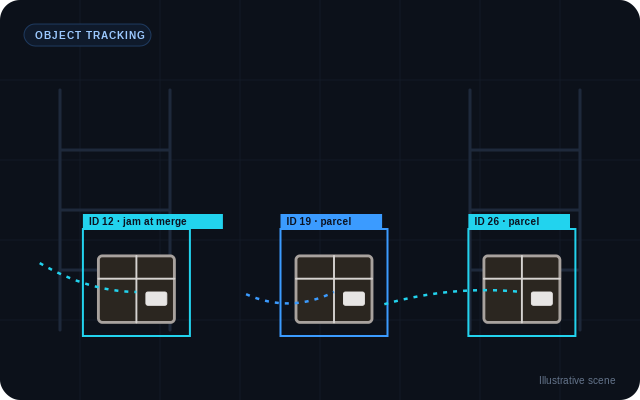
What can be checked
- Parcels passing a point
- Jams and pile-ups at merges
- Overlapping or side-by-side parcels
What the team receives
- Counts per time interval
- Jam alerts with location
What the solution does
Throughput visibility
Measures parcel flow continuously at key conveyor points.
Faster jam response
Detects stopped, piled-up or stuck parcels on conveyors and alerts operators, so jams are cleared before they back up the line.
Process insight
Shows the conveyor points where jams and overflows recur, which helps engineers prioritize mechanical fixes.
The operational problem
Jams at merges and inductions stop flow and are often noticed late. Throughput data from scanners can be incomplete.
How visual intelligence helps
Overhead cameras detect and track parcels through merges, inductions and chutes. When parcels accumulate abnormally or stop moving, operators get an alert with the location before the jam spreads.
Example visual workflow
- Overhead cameras view conveyor sections.
- Parcels are detected and tracked.
- Counts and flow are computed.
- Jams trigger alerts to operators.
Illustrative workflow — the actual pipeline is designed for each site during the PoC.
Edge deployment considerations
Edge processing near the conveyor keeps alert latency low, which matters when a jam can back up a line within seconds. Counts are exported to throughput dashboards.
How the solution is built
AI capabilities
The AI tasks this use case combines.
- Counting and Measurement
Counting and measurement convert detections, tracks and masks into quantities — how many objects, how long they stayed, how big they are, how full an area is.
- Object Tracking and Multi-Object Tracking
Object tracking links detections of the same object across consecutive video frames and assigns each one a persistent ID.
Visual inputs
Cameras and imaging that typically supply the video.
- IP and Network Cameras
IP cameras stream digital video over standard networks and are the most common source for Edge AI video analytics.
Deployment options
General approaches to evaluate, not tested hardware. Specific hardware is selected and validated for each project during the PoC.
- Camera and VMS Integration
Most projects start with cameras that are already installed.
- Edge AI Hardware Sizing
Sizing Edge AI hardware means matching compute, memory, power and enclosure to the real workload — the number of streams, resolution, frame rate, models and latency targets — under the site's environmental and installation constraints.
- Edge Deployment Architectures
Edge-first means processing video at or near where it is captured.
Practical factors to plan for
Real-world results depend as much on the environment and camera setup as on the model.
Site and setup
- Mounting. Overhead cameras give the clearest view.
- Parcel variety. Bags and irregular items must be included in training data.
Human review
Operators confirm jam alerts and clear the line. Counts are compared with scanner data.
Limitations & scope
- Very dense flows reduce counting accuracy.
- Counts do not replace scanner-based tracking.
Proof of Concept
Have a visual AI challenge? Let's prove it.
Share a video of what happens in your environment and describe the outcome you need. We review every request for technical feasibility, then agree the scope of a focused Proof of Concept (PoC) with you.
Example request: “We want alerts when parcels pile up at the merge before our sorter induction.”
Every request is reviewed for technical feasibility. PoC scope, timing and terms are agreed individually.
Related topics
How this page connects to industries, use cases, AI tasks, input sources and deployment options.