IndustryRobot cells, AMRs and automated lines
Edge AI Video Intelligence for Robotics and Automation
Robots and automated systems increasingly depend on vision to locate parts, navigate spaces and verify their own work. Edge AI video intelligence provides perception that runs on or next to the robot — for picking, placement, navigation and workspace safety awareness.
Common challenges
- Parts arrive in varied positions that fixed fixtures cannot handle.
- Robots must adapt to product changes without lengthy reprogramming.
- Mobile robots need reliable perception in changing environments.
- People and robots increasingly share workspaces.
Typical visual sources
- Wrist-mounted and cell-mounted cameras on robot arms
- Depth and 3D cameras for picking and placement
- Cameras on autonomous mobile robots
Potential applications
Vision-guided picking
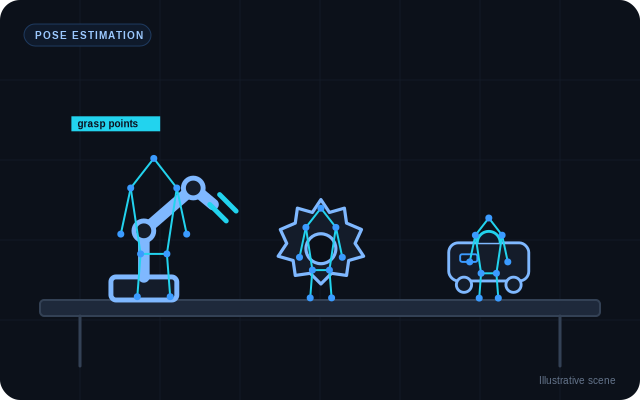
Locate parts in bins or on conveyors and provide grasp positions to the robot.
Pose and orientation
Estimate the orientation of parts so robots can place them correctly.
In-cell verification
Check that the robot has picked, placed or assembled correctly.
Workspace awareness
Detect people entering robot work areas as an additional awareness layer.
Where video intelligence fits
Automation is moving from fixed, fully defined tasks to flexible ones, and flexibility depends on perception. Edge AI gives robots the ability to see variable parts and environments with latency suited to motion.
Typical Edge architecture
Vision runs on an Edge computer in the cell or on onboard compute of mobile robots, exchanging results with the robot controller through supported interfaces.
Questions to answer early
- How varied are the parts and their presentation?
- Which robot controller and interfaces are used?
- What cycle time must perception meet?
Limitations & scope
- Robot motion and safety functions remain with the controller and certified safety systems.
- Hand-eye calibration and controller integration are substantial engineering tasks.
- Transparent, reflective or deformable objects remain hard to handle reliably.
Proof of Concept
Have a visual AI challenge? Let's prove it.
Share a video of what happens in your environment and describe the outcome you need. We review every request for technical feasibility, then agree the scope of a focused Proof of Concept (PoC) with you.
Example request: “We want a robot to pick randomly oriented brackets from a bin; can vision find reliable grasp points?”
Every request is reviewed for technical feasibility. PoC scope, timing and terms are agreed individually.
Frequently asked questions
Do you work with robot integrators?
Vision projects are often delivered alongside the integrator responsible for the robot cell. Responsibilities are agreed per project.
Can vision run on the robot itself?
On mobile robots with suitable compute, yes. Robot arms usually use an Edge computer in the cell.
Related topics
How this page connects to industries, use cases, AI tasks, input sources and deployment options.
Use Cases
- AMR Obstacle Perception
- Crop Row Detection for Machine Guidance
- Depalletizing Guidance
- Object Pose Estimation for Robotics
- Part Orientation Detection
- Pick-and-Place Guidance
- Ripeness and Harvest Readiness
- Robot Workspace Monitoring
- Robotic Visual Inspection
- Vision-Guided Bin Picking
- Wire Harness and Connector Inspection