Use CaseCanopy, height and growth stages
Plant Growth Monitoring
Track plant canopy cover, height and growth stages over time in greenhouses, vertical farms and trial fields to support crop management and research.
What can be checked
- Canopy cover
- Plant height and growth stage
- Uneven growth between areas
What the team receives
- Growth curves per area
- Alerts on unusual growth
What the solution does
Growth curves
Measures plant size, canopy cover and color over time, producing growth curves for each bed, bench or plot.
Uniformity insight
Highlights zones and benches where plants lag behind, which can point to irrigation, lighting or climate problems.
Research support
Produces repeatable, image-based measurements that make trials and variety comparisons easier to evaluate.
The operational problem
Growth is usually assessed by eye or by occasional manual measurements, which makes it hard to compare treatments or detect lagging areas early.
How visual intelligence helps
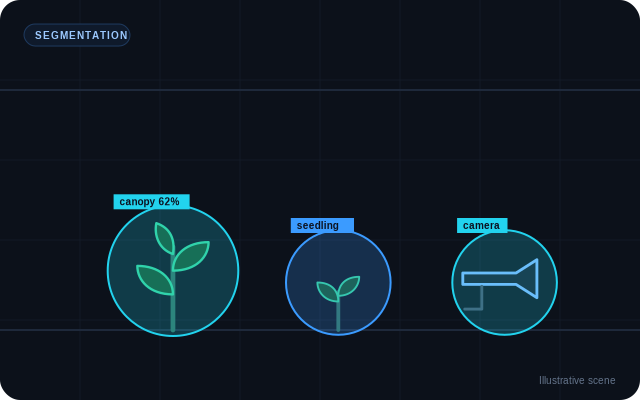
Fixed cameras capture plants regularly and segmentation calculates canopy cover and other growth metrics, producing curves per area.
Example visual workflow
- Cameras capture plants at regular intervals.
- Canopy and plants are segmented.
- Growth metrics are calculated.
- Trends are reported per area.
Illustrative workflow — the actual pipeline is designed for each site during the PoC.
Edge deployment considerations
Compact Edge devices capture and analyze images on site and send metrics to farm management software.
How the solution is built
AI capabilities
The AI tasks this use case combines.
- Counting and Measurement
Counting and measurement convert detections, tracks and masks into quantities — how many objects, how long they stayed, how big they are, how full an area is.
- Semantic Segmentation
Semantic segmentation assigns a class to every pixel of an image — road, floor, water, smoke, crop, background — producing a map of regions rather than individual objects.
Visual inputs
Cameras and imaging that typically supply the video.
- Depth, Stereo and 3D Cameras
Depth cameras measure distance to every point in view, using stereo vision, structured light or time-of-flight.
- IP and Network Cameras
IP cameras stream digital video over standard networks and are the most common source for Edge AI video analytics.
- Multispectral and Hyperspectral Cameras
Multispectral cameras capture several specific wavelength bands; hyperspectral cameras capture many narrow bands per pixel.
Deployment options
General approaches to evaluate, not tested hardware. Specific hardware is selected and validated for each project during the PoC.
- Camera and VMS Integration
Most projects start with cameras that are already installed.
- Edge AI Hardware Sizing
Sizing Edge AI hardware means matching compute, memory, power and enclosure to the real workload — the number of streams, resolution, frame rate, models and latency targets — under the site's environmental and installation constraints.
- Edge Deployment Architectures
Edge-first means processing video at or near where it is captured.
- Industrial and Ruggedized Edge AI Computers
Industrial Edge AI computers and ruggedized systems house AI-capable processors in enclosures built for factories, vehicles and outdoor sites — wide temperature ranges, vibration, dust and industrial power.
Practical factors to plan for
Real-world results depend as much on the environment and camera setup as on the model.
Site and setup
- Consistent capture. Images must be taken from fixed positions and under similar light.
- Scale. Height measurement needs depth data or references.
Human review
Growers and researchers interpret growth data alongside their own observations.
Limitations & scope
- Overlapping plants limit individual measurements.
- Lighting changes can affect results.
Proof of Concept
Have a visual AI challenge? Let's prove it.
Share a video of what happens in your environment and describe the outcome you need. We review every request for technical feasibility, then agree the scope of a focused Proof of Concept (PoC) with you.
Example request: “We want daily canopy cover curves for each rack in our vertical farm.”
Every request is reviewed for technical feasibility. PoC scope, timing and terms are agreed individually.
Related topics
How this page connects to industries, use cases, AI tasks, input sources and deployment options.