Use CaseSize, color and visible defects
Produce Grading and Sorting
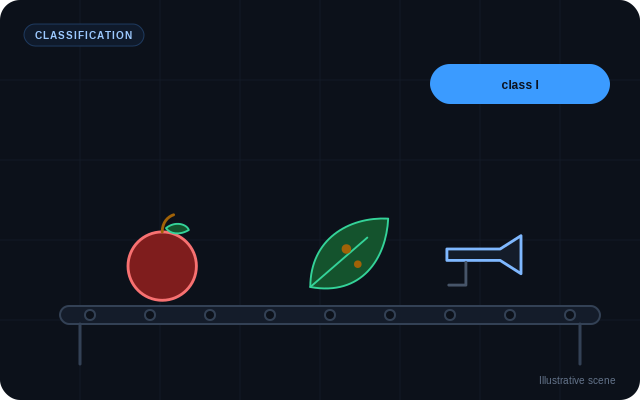
Grade fruit, vegetables and nuts by size, color and visible defects on packing lines to support sorting into quality classes.
What can be checked
- Size and shape
- Color and ripeness indicators
- Bruises and blemishes
What the team receives
- Grade per item
- Batch quality statistics
What the solution does
Consistent grading
Applies the same size, color and defect rules across the whole day, reducing variation between graders and shifts.
Batch insight
Measures quality distributions for each grower or delivery, giving buyers objective data for payment and feedback.
Flexible classes
Grade classes can be adjusted to different customer specifications without changing the mechanical sorting line.
The operational problem
Manual grading of fruit and vegetables is inconsistent between staff and shifts and limits packhouse throughput.
How visual intelligence helps
Cameras view each item from several sides as it rotates on rollers, measuring size, color and visible blemishes. A grade is assigned and sorting equipment routes items into classes.
Example visual workflow
- Items pass cameras on rollers.
- Size color and defects are measured.
- A grade is assigned.
- Sorting equipment routes items.
Illustrative workflow — the actual pipeline is designed for each site during the PoC.
Edge deployment considerations
Grading runs on Edge computers at the line to keep pace with throughput. Grade rules can be adjusted per customer specification.
How the solution is built
AI capabilities
The AI tasks this use case combines.
- Counting and Measurement
Counting and measurement convert detections, tracks and masks into quantities — how many objects, how long they stayed, how big they are, how full an area is.
- Image and Object Classification
Classification assigns a label to a whole image or to an individual object crop — good or defective, running or stopped, product variant A or B.
Visual inputs
Cameras and imaging that typically supply the video.
- Industrial and Machine Vision Cameras
Industrial and machine vision cameras capture sharp, consistent images at fixed positions with controlled lighting and triggering.
- Multispectral and Hyperspectral Cameras
Multispectral cameras capture several specific wavelength bands; hyperspectral cameras capture many narrow bands per pixel.
Deployment options
General approaches to evaluate, not tested hardware. Specific hardware is selected and validated for each project during the PoC.
- Edge AI Hardware Sizing
Sizing Edge AI hardware means matching compute, memory, power and enclosure to the real workload — the number of streams, resolution, frame rate, models and latency targets — under the site's environmental and installation constraints.
- Edge Deployment Architectures
Edge-first means processing video at or near where it is captured.
- Industrial and Ruggedized Edge AI Computers
Industrial Edge AI computers and ruggedized systems house AI-capable processors in enclosures built for factories, vehicles and outdoor sites — wide temperature ranges, vibration, dust and industrial power.
Practical factors to plan for
Real-world results depend as much on the environment and camera setup as on the model.
Site and setup
- Rotation. Items should be seen from several sides.
- Seasonal variation. Appearance changes across varieties and seasons.
Human review
Packhouse staff review grade settings and sample results.
Limitations & scope
- Internal defects require other sensors.
- Integration with sorters depends on suppliers.
Proof of Concept
Have a visual AI challenge? Let's prove it.
Share a video of what happens in your environment and describe the outcome you need. We review every request for technical feasibility, then agree the scope of a focused Proof of Concept (PoC) with you.
Example request: “We want to grade avocados by visible blemishes into three classes on our packing line.”
Every request is reviewed for technical feasibility. PoC scope, timing and terms are agreed individually.
Related topics
How this page connects to industries, use cases, AI tasks, input sources and deployment options.