Use CasePainted, stamped and labeled identifiers
Slab and Coil ID Reading
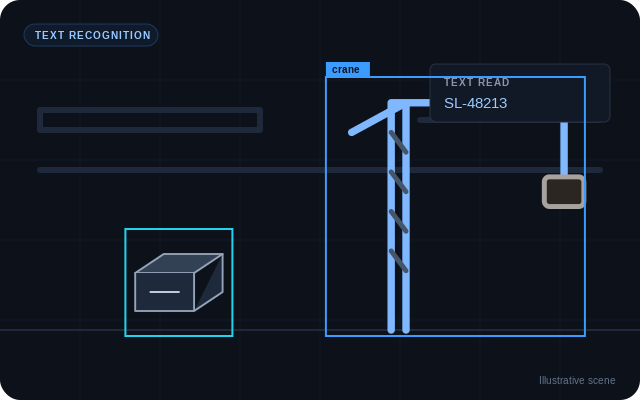
Read painted, stenciled or stamped identifiers on slabs, billets, coils and bundles to support material tracking through yards and process steps.
What can be checked
- Painted or stenciled slab and billet numbers
- Stamped or labeled coil identifiers
- Bundle tags
What the team receives
- Recognized ID with confidence
- Match result against expected material
What the solution does
Automatic tracking
Reads painted, stamped or tagged material IDs from images, reducing manual typing in the mill and yard.
Mix-up prevention
Flags material that does not match the schedule.
Yard visibility
Supports location records in storage yards.
The operational problem
Material mix-ups are costly in metal production. Manual reading and typing of identifiers is slow and error-prone, especially in hot, dirty areas.
How visual intelligence helps
Cameras read identifiers at checkpoints and compare them with the production schedule, flagging mismatches before processing.
Example visual workflow
- A camera captures the identifier as material passes a checkpoint.
- OCR reads the characters and estimates confidence.
- The ID is compared with the expected material.
- Mismatches or low confidence are routed to operators.
Illustrative workflow — the actual pipeline is designed for each site during the PoC.
Edge deployment considerations
OCR runs on Edge computers near the checkpoints and sends recognized IDs to the plant’s tracking system.
How the solution is built
AI capabilities
The AI tasks this use case combines.
- Object Detection
Object detection finds and labels the objects in an image or video frame and marks each one with a bounding box.
- OCR and Text Recognition
Optical character recognition (OCR) reads text visible in images — labels, codes, container numbers, displays and gauges.
Visual inputs
Cameras and imaging that typically supply the video.
- IP and Network Cameras
IP cameras stream digital video over standard networks and are the most common source for Edge AI video analytics.
- Thermal and Infrared Cameras
Thermal cameras image heat (long-wave infrared), while near-infrared cameras use invisible illumination to see in darkness.
Deployment options
General approaches to evaluate, not tested hardware. Specific hardware is selected and validated for each project during the PoC.
- Camera and VMS Integration
Most projects start with cameras that are already installed.
- Edge AI Hardware Sizing
Sizing Edge AI hardware means matching compute, memory, power and enclosure to the real workload — the number of streams, resolution, frame rate, models and latency targets — under the site's environmental and installation constraints.
- Edge Deployment Architectures
Edge-first means processing video at or near where it is captured.
- Industrial and Ruggedized Edge AI Computers
Industrial Edge AI computers and ruggedized systems house AI-capable processors in enclosures built for factories, vehicles and outdoor sites — wide temperature ranges, vibration, dust and industrial power.
Practical factors to plan for
Real-world results depend as much on the environment and camera setup as on the model.
Site and setup
- Marking quality. Faded, smeared or partially covered markings reduce read rates.
- Heat and scale. Hot surfaces glow and scale can hide characters.
Human review
Low-confidence reads are confirmed by operators before material records are updated.
Limitations & scope
- Unreadable markings still require manual identification.
- Character sets and formats must be defined in advance.
Proof of Concept
Have a visual AI challenge? Let's prove it.
Share a video of what happens in your environment and describe the outcome you need. We review every request for technical feasibility, then agree the scope of a focused Proof of Concept (PoC) with you.
Example request: “We want to read stenciled slab numbers at our reheating furnace entry.”
Every request is reviewed for technical feasibility. PoC scope, timing and terms are agreed individually.
Related topics
How this page connects to industries, use cases, AI tasks, input sources and deployment options.