Use CaseThermal and visual equipment checks
Substation Monitoring
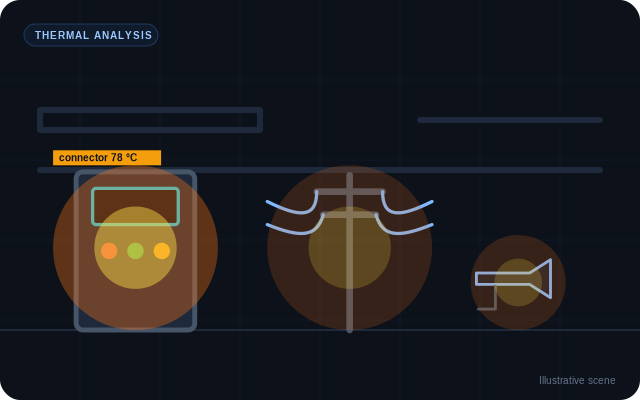
Monitor substation equipment with thermal and visual cameras to highlight overheating connections, oil leaks, open doors and intrusions.
What can be checked
- Overheating connections
- Oil leaks and spills
- Intrusions and open doors
What the team receives
- Thermal alerts and trends
- Security events
What the solution does
Continuous monitoring
Watches unattended substations continuously between visits.
Early warning
Tracks temperature trends on transformers, connections and switchgear, highlighting components that are heating up abnormally.
Security
Detects people or vehicles entering the site.
The operational problem
Substations are unattended and periodic inspections can miss developing faults.
How visual intelligence helps
Thermal and visual cameras watch equipment continuously, tracking temperature trends and detecting oil leaks, open doors and intrusions. Operators receive alerts with images for verification.
Example visual workflow
- Cameras observe equipment.
- Temperatures and events are analyzed.
- Alerts are sent.
- Operators verify.
Illustrative workflow — the actual pipeline is designed for each site during the PoC.
Edge deployment considerations
Edge devices at substations analyze video locally and send only events, which suits limited communication links.
How the solution is built
AI capabilities
The AI tasks this use case combines.
- Object Detection
Object detection finds and labels the objects in an image or video frame and marks each one with a bounding box.
- Visual Anomaly Detection
Visual anomaly detection learns what normal looks like and flags images, regions or events that deviate from it.
Visual inputs
Cameras and imaging that typically supply the video.
- IP and Network Cameras
IP cameras stream digital video over standard networks and are the most common source for Edge AI video analytics.
- Thermal and Infrared Cameras
Thermal cameras image heat (long-wave infrared), while near-infrared cameras use invisible illumination to see in darkness.
Deployment options
General approaches to evaluate, not tested hardware. Specific hardware is selected and validated for each project during the PoC.
- Camera and VMS Integration
Most projects start with cameras that are already installed.
- Edge AI Hardware Sizing
Sizing Edge AI hardware means matching compute, memory, power and enclosure to the real workload — the number of streams, resolution, frame rate, models and latency targets — under the site's environmental and installation constraints.
- Edge Deployment Architectures
Edge-first means processing video at or near where it is captured.
- Industrial and Ruggedized Edge AI Computers
Industrial Edge AI computers and ruggedized systems house AI-capable processors in enclosures built for factories, vehicles and outdoor sites — wide temperature ranges, vibration, dust and industrial power.
Practical factors to plan for
Real-world results depend as much on the environment and camera setup as on the model.
Site and setup
- Thermal setup. Emissivity and viewing angles matter.
- Remote sites. Substations are unattended.
Human review
Operators verify alerts and dispatch crews.
Limitations & scope
- Thermal readings are indicative.
- Not a replacement for protection systems.
Proof of Concept
Have a visual AI challenge? Let's prove it.
Share a video of what happens in your environment and describe the outcome you need. We review every request for technical feasibility, then agree the scope of a focused Proof of Concept (PoC) with you.
Example request: “We want temperature trend alerts for transformer bushings at three unattended substations.”
Every request is reviewed for technical feasibility. PoC scope, timing and terms are agreed individually.
Related topics
How this page connects to industries, use cases, AI tasks, input sources and deployment options.